
How can you tell a first printing of Berserk?
Japanese books confess their printing history at the back. Berserk’s first printings speak Jets Comics.
Every Japanese book carries a colophon, the small print block at the back, recording its edition and printing dates. Collecting Berserk in Japanese is mostly the art of reading that block: a true first printing of volume 1 is a Jets Comics book whose colophon shows the first-edition date, December 1, 1990, days after the book went on sale on November 26.
THE THREE TESTS
Colophon · banner · band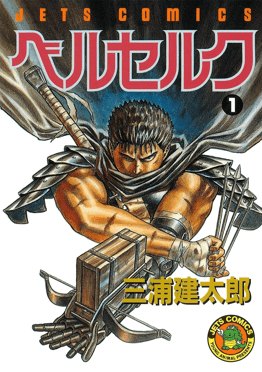
Volume 1 · Jets Comics · 1990
The first cover under the Jets banner, ISBN 4-592-13574-1. Decades of reprints share this art, so the cover alone never proves a first printing. The colophon does.
The colophon test
Open the back of the book. Japanese colophons list the first-edition date and then each printing in sequence. A first printing shows the original edition date with no later printings beneath it. For volume 1 that date is December 1, 1990. Any Berserk volume, any era: the last page outranks the cover.
The two banners
From 1990 to 2016 the books are Jets Comics. In June 2016 the label became Young Animal Comics and volumes 1 to 37 were reissued with new covers and new ISBNs; volume 38 onward was born under the new name. A Jets banner dates a copy to the first era, but Jets printings ran for twenty-six years, so the banner is a starting clue, never the verdict.
THE FINISHING DETAILS
What separates the best copiesThe obi
First-era Berserk volumes shipped with a paper advertising band, the obi, which most readers threw away. A first printing with its obi intact is the complete object as sold in 1990, and priced like it.
The special editions
The modern end of the shelf has its own firsts: volumes 41, 42 and 43 each arrived with special editions, canvas art and a drama CD for 41, figure-bundled editions for 42 and 43. These were order-window objects, and their print runs were the window.