
How did Kentaro Miura draw Berserk?
Pen, ink, and patience: the densest line in mainstream manga, drawn at walking pace.
Open any Berserk volume at random and the method announces itself: architecture, armour and weather all finished to the same pitch of detail, crowd scenes in which the crowd is actually drawn. Japanese readers have a shorthand for it, dense and heavy, and in 2002 the industry made it official with the Excellence Prize at the Tezuka Osamu Cultural Prize. The question is how a hand sustains that for three decades.
THE TRAINING
Art school and apprenticeships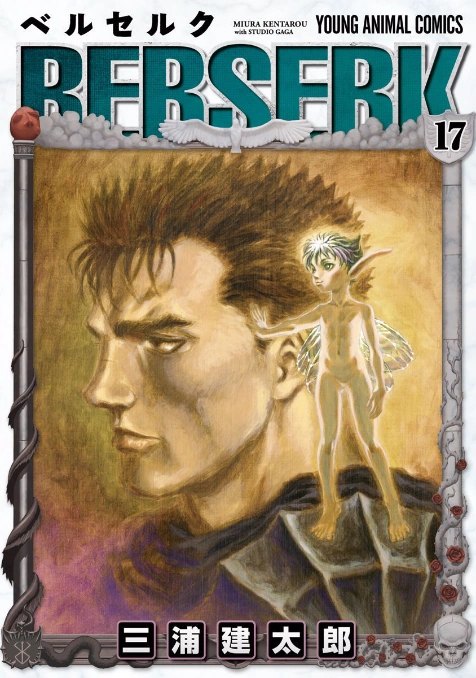
Volume 17 · 1999
The painted covers are part of the method too: Miura finished his books the way he finished his pages, in full, whether the surface was a chapter or a jacket.
Before Berserk
Miura drew his first classroom manga at ten, worked the doujinshi scene in high school, and studied art at university, where a submission piece earned a nomination in Kodansha’s new-author competition. He also assisted George Morikawa, later of Hajime no Ippo: Morikawa saw Berserk sketches in the young Miura’s sketchbook as early as 1984, five years before the series existed.
The studio, not the lone hand
The lone-genius story is only half true. Miura worked with assistants at his own Studio Gaga, trained in his manner; it is the same studio that draws the series today. What he did not delegate was the standard: the density is a house rule he set and enforced.
THE COST OF THE LINE
Schedule as evidenceRead the dates
The volume dates on the manga gallery page are the method’s ledger: forty-one volumes in thirty-one years, hiatuses that sometimes ran to years, a pace the publisher’s own histories describe without embarrassment. Berserk appeared when a chapter could survive its author’s standards.
Why it holds up
Density dates a page only when it is decoration. Miura’s detail is structural: stone, cloth and flesh each get their own mark-making, so a page from 1993 and a page from 2019 read as one continuous world.