
From the Library: covers, censuses, and editions, documented. Browse the Library →
SOJ The Method ยท Blade of the Immortal
← Back to the Library

How Does Hiroaki Samura Draw Blade of the Immortal?

He draws like a painter who happens to work in panels: pencil first, ink second, tone last and least.

Open any volume of Blade of the Immortal at random and the first thing a manga reader notices is what is missing. The grey in these pages is not screentone, the pre-printed dot sheets most manga shading is built from. It is pencil: hatched, smudged, layered graphite, laid down by a classically trained hand and very often left exactly as it fell. Samura mixes pen-and-ink passages with panels that are pure pencil work, sketch-textured and un-inked, and he switches between the two inside a single page on purpose.

Reviewers noticed from the first English volume onward. The Amazon editorial review of volume 1 described pencil drawings combined with pen-and-ink work; later readers describe the shift precisely: crisp inked detail for stillness, soft-lead pencil for speed, so that a duel blurs like a photograph of motion while the conversation before it stands in hard focus. Kodansha itself marked the end of the run in 2012 by streaming a time-lapse video of Samura sketching Manji, from the first lines to the finished shading: the publisher knew the hand was the attraction.
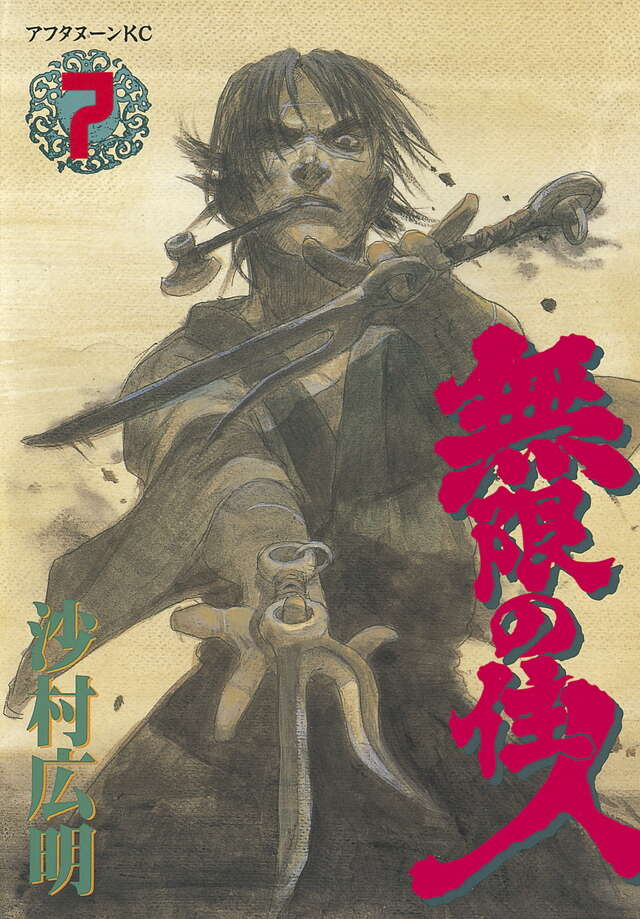
Blade of the Immortal volume 7 Japanese cover, Afternoon KC
VOLUME 7Volume 7 of the Japanese tankobon, Afternoon KC. Samura painted all thirty covers himself, and they were never redesigned.

THE METHOD, PART BY PART

How a page is built
The pencil layer
Faces, drapery and atmosphere are modelled in graphite. Pencil lets Samura grade a shadow the way a painter grades paint, in strokes rather than in mechanical dots, and the printed page keeps the grain of it.
The ink layer
Where a contour must hold, weapons, eyes, the edge of a blade, the pencil is reinforced or replaced by pen and ink. The contrast between the two layers is the series' visual signature.
The hatching
Shadow is built from crossed lines, not tone sheets. Readers comparing the book to Nausicaa of the Valley of the Wind have made the same observation: the darkness in Samura is drawn, never applied.
The covers
The thirty tankobon covers are a separate practice again: full paintings, one per book, documented in the gallery. The art book page collects where that colour work was gathered.

THE ARRANGEMENT

Pages composed like storyboards
Style switching
Samura changes drawing style between panels as a storytelling device: the sketchier the panel, the faster or more dreamlike the moment. The technique is deliberate enough that critics discuss it the way they discuss a film editor's cuts.
The stated aim
Against all this visible labour stands Samura's own instruction for reading him, from his 1997 Dark Horse interview: do not obsess about the details, just look at the story. The detail is there to be felt, not counted.
The training underneath
None of it is accidental. Samura studied oil painting at art school before Afternoon took him; the pencil naturalism is a fine-art habit carried into a monthly magazine, which is why it never looks like anyone else's manga.
More from the Library
MORE FROM THE BLADE OF THE IMMORTAL ARCHIVE →
One shelf of the Library. Browse them all →

THE FIRST WORD

New pages and new pieces, first.