
How is the Japanese Contra different from the American one?
Both games arrived the same week, the Famicom version on February 9, 1988 and the NES version on February 12. The difference is a chip. In Japan, Konami built its cartridge on its own VRC2 mapper, as Japanese third parties were free to do. For America, the game was moved onto Nintendo's cheaper UNROM board at half the ROM size, and everything decorative was spent to fit.
What the Japanese space bought: a prologue setting out the backstory (the year 2633, the Galuga archipelago), a title screen with animated flames, a map of the archipelago before every stage, cutscenes between stages where Bill, or Lance in the two-player conditions, radios in a status report, and one extra music track. The stages themselves move: palm trees whip in the wind in stage one, snow falls through stage five. The ending runs longer, the heroes boarding their helicopter, with a flag added for each completed loop, up to six; the credits run letterboxed, and holding Select and Start through them reveals a secret message. Sound test and stage select round out the extras.
America even lost the setting on paper: the US manual relocated the game from 2633's Galuga islands to the present-day Amazon. The run-and-gun is identical. Everything around it, the story, the weather, the reward for looping, is Japanese.
THE TWO BOXES
One painting each, two different promisesContra, 1988
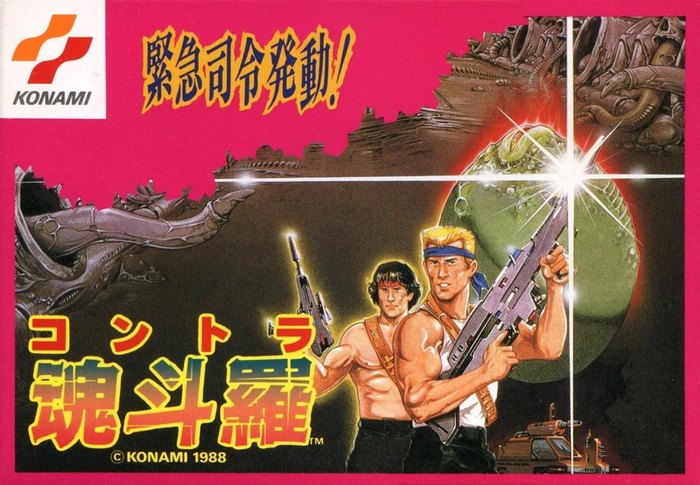
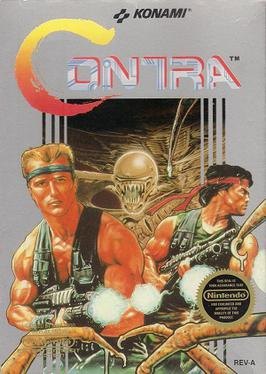
The boxes promise the same game, and the shooting delivers it. The difference is everything the bigger Japanese cartridge carried around the shooting.