How was Akira made?
The condition came first. Otomo did not intend to adapt his manga, and agreed to the film only on the condition that he retained creative control of the project, an insistence he based on his experience working on the 1983 film Harmagedon. The animation was produced by Tokyo Movie Shinsha, today TMS Entertainment, and Toho distributed the finished film in Japan.
No single company carried a budget this size alone, so the money and promotion came from a partnership the record names the Akira Committee: the publisher Kodansha, Mainichi Broadcasting System, Bandai, Hakuhodo, the distributor Toho, LaserDisc Corporation and Sumitomo Corporation, with Tokyo Movie Shinsha producing the animation. The committee existed, in the production record's own terms, because the starting budget was unconventionally high for an animated film and the aim was a scale equal to a manga of more than 2,000 pages.
The budget deserves to be printed the way the record actually holds it, in steps, because the famous single figure is disputed. The starting budget was around 500 million yen. The production budget is documented at 700 million yen, about $5.5 million at the time. The larger figure of 1.1 billion yen, about $9 million, is the combined production and advertising total as usually reported, and in June 2020 a producer on the film, Shigeru Watanabe, publicly corrected the record to say the production cost itself was less than 1.1 billion yen. The often repeated claim that this made it the most expensive anime film of its day is likewise printed here as a claim, not a settled fact: it is disputed in the current record.
The sound was made backwards, by Japanese practice. Akira had pre-scored dialogue: the actors recorded their lines before the animation was produced, working with the aid of animatics, and the characters' lip movements were then animated to match the recorded voices. The production record calls this a first for an anime production and extremely unusual even today; the normal Japanese method, then and now, records voices to finished pictures. The score went the opposite way to a conventional film score as well in its materials: composed by Shoji Yamashiro and performed by his collective Geinoh Yamashirogumi, it is built from Indonesian gamelan and jegog, Japanese noh and Buddhist chant.
The scale figures are printed at the weight their sourcing carries. The film's more than 160,000 animation cels is the figure carried in the production notes published with the English comics edition in 1988, and it is the number behind the film's famously fluid motion at a running time of 124 minutes. Otomo is claimed to have filled 2,000 pages of notebooks with ideas and designs for the film, trimmed to a final storyboard of 738 pages; the notebook total is reported as a claim in the record, and this page prints it as one. Computer graphics were used, but narrowly: to animate Doctor Onishi's pattern indicator, to plot the paths of falling objects, to model parallax on backgrounds, and to adjust lighting and lens flares. The city itself was drawn.
THE PRODUCTION, IN NUMBERS
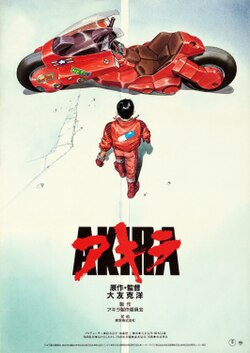
Each figure labeled with its weightTHE POSTER
The image the production sold