The sakabatō: Kenshin’s reverse-blade sword
The sakabatō is forged with its cutting edge along the inner curve of the blade and its dull spine outward, so that a full-power strike lands with the back of the sword. In the manga both of Kenshin’s are the work of the swordsmith Arai Shakkū, who came to regret his killing blades: the first sakabatō breaks in the duel with Sōjirō, and the second, Shakkū’s final work, waited enshrined as an offering before his son Seikū surrendered it to Kenshin. The object is the series’ thesis in steel: the same length, weight and skill as a killing sword, re-forged so its default is mercy.
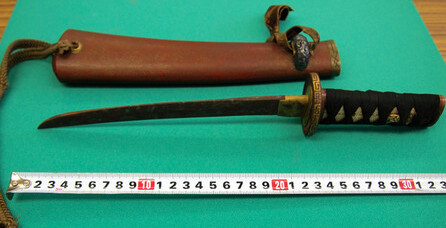
And then reality produced one. In October 2013, a family storehouse in Shiroi City, Chiba, yielded a small reverse-edged blade, a kogatana 28.2 cm long overall with a 22.6 cm blade, engraved with dragons and dated to the Edo period. Experts found no comparable entry in the official sword registries; the blade was donated to the prefecture and shown at Shiroi’s local history museum, reported across Japan as the discovery of a “real sakabatō.” It is a short utility blade, not a duelling katana, and why it was made remains unknown, but Kenshin’s pure invention turned out to have one small ancestor.