
The History of ActRaiser
ActRaiser (Super Nintendo, 1990) was Quintet's first game, and it is still the strangest shape on this shelf: half side scrolling action game, half city building simulation, played as a god rebuilding a world that has stopped believing in him. Enix published it in Japan on December 16, 1990, within weeks of the Super Famicom launch, and it made two reputations at once, Quintet's and composer Yuzo Koshiro's.
THE BOXES
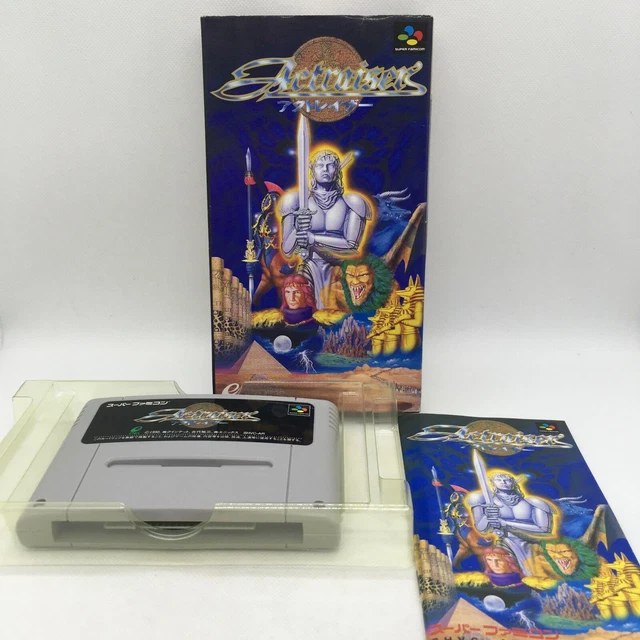
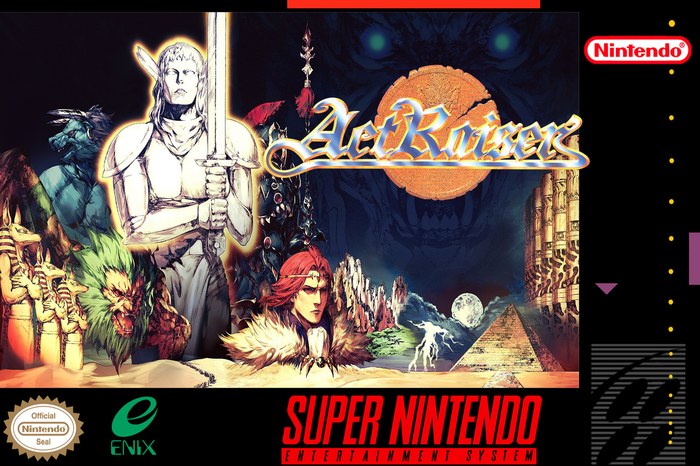
One painting serves both territories, which is rarer on this shelf than it sounds. What changed for America was not the art but the words and the difficulty, documented in the making section below.
THE MAKING
A first game, from the Ys teamQuintet was founded in April 1989 by Tomoyoshi Miyazaki, scenario writer on the first three Ys games, and Masaya Hashimoto, who had directed, designed, and programmed those same games at Nihon Falcom. Hashimoto directed ActRaiser; Yasuyuki Sone produced; Miyazaki wrote; and Ayano Koshiro, the composer's sister, designed the characters. The studio name itself counts the five crafts of game making: planning, graphics, sound, programming, and production.
The premise is a monotheism allegory, and the original Japanese version says so outright: the protagonist is named God and the antagonist Satan. Nintendo of America's content policy in the early 1990s prohibited overtly religious material, so for the West they became The Master and Tanzra, the monster lairs' symbols were redrawn, and the allegory carried on anyway, sky palace, angel, miracles, prayers and all.
The Western versions are tuned differently, not just renamed. In North America the action stages were made easier and the simulation made harder, with a Professional mode of action only stages, at Japanese difficulty, unlocked at the end. Europe built on that version, renamed the extra mode Action, opened it from the start, and added difficulty settings that in one Expert configuration go beyond every earlier version.
THE DESIGN
Two games taking turnsThe player never controls the Master directly. In the action stages he animates a statue and fights through platforms to a boss. In the simulation he works through an angel, guiding a newborn civilization from two people upward: planning roads, calling down lightning, rain, sunlight, wind, and earthquakes as miracles, and protecting the builders from flying monsters until the people can seal the four monster lairs in each land themselves. Population is the experience system: as the world fills, the Master levels up.
The ending is the part players remember decades later. With Tanzra beaten, the Master revisits his civilizations and finds the temples empty. The people, able to solve their own problems now, no longer need him, so he and his servant depart into the heavens to wait for a time when they might be needed. A god game that ends with god politely leaving is not a 1990 plot beat anyone else was writing.
THE MUSIC
Koshiro, and the score that set the barYuzo Koshiro's score is central to what this game is, and the record is unusually complete. Landing within six months of the console's launch, it demonstrated what the Super Nintendo sound hardware could do with high quality samples in skilled hands. A soundtrack album followed in Japan on January 25, 1991, and an arranged Symphonic Suite that September. A medley was performed live at the Symphonic Game Music Concert in Leipzig in 2004. Electronic Gaming Monthly named it Best Music of 1993, two years after the American release, which is how long the impression lasted.
The afterlife kept going: Wayo Records reissued the soundtrack on vinyl and CD in 2021, and for the 2021 remake Koshiro returned to recreate the original score in full and compose fifteen new tracks, each in both period sample style and the remake's higher fidelity audio.
THE EDITIONS
1990 to a 2021 remakeTHE RECEPTION
Acclaim, with the dissent keptQuintet reported 620,000 copies sold worldwide: 400,000 in Japan, 180,000 in North America, and 40,000 in Europe. The split matters for collectors: the Japanese edition is the common one, the European the scarce one, and the American sits between.
THE LEGACY
The half that got awayGameSpot inducted ActRaiser into its Greatest Games of All Time in December 2003, and EGM's all time ranking praised the combination of styles and an atmosphere it called more like a religious experience than anything else on the system. The sequel, ActRaiser 2 (1993), kept the action and dropped the simulation entirely, which settled the argument about which half the audience had loved: the building, and the leaving, were the game. It took the 2021 Renaissance remake to put the two halves back together.