
The History of Bahamut Lagoon
Bahamut Lagoon (Super Famicom, 1996) is a tactical RPG built by a team of Square newcomers in the company's final Super Famicom season: squad-based grid battles where every squad leader brings a dragon, and the dragons are raised by feeding, fond of some foods and soured by others, and not under the player's direct control. It sold over 474,600 copies in Japan. It has never been officially released outside Japan. This page says that plainly because the game's whole Western history is fan translation.
THE BOX
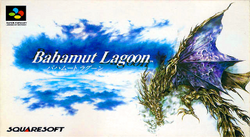
No Western box exists and none is substituted here: no later-port box, no remake box, because there has never been a Western release in any form. The staged file is 250px wide, below the Library's working standard, and is a swap-in upgrade when a larger scan is verified.
THE MAKING
A newcomer team's own project, 1994 to 1996The concept came from Hitoshi Sasaki, a graphic designer from Final Fantasy VI, who described it as a game he had wanted to make for a long time. Programmer Hiroshi Ono brought Hironobu Sakaguchi a proposal: a team of new Square developers making their own project. Sakaguchi, a fan of tactical RPGs, approved it; the game was originally titled Final Fantasy Tactics, a name that would shortly belong to another game entirely. Production ran two years from 1994 in Square's Development Department 6.
Director Kazushige Nojima had joined from Data East in 1994, from the Glory of Heracles series. The scenario was written by Motomu Toriyama, also a 1994 arrival, who took the role, by his own account, because no one else did; the story's complex relationships and betrayals drew directly on events in his life. Sasaki's setting came from memory: flying over the Izu Peninsula, he wanted the feeling of floating lagoons, and the world of Orelus, continents adrift in the sky, followed. The score, by Noriko Matsueda, her second major game after co-composing Front Mission, aimed at an orchestral impression inside the Super Famicom's limits, built from reverb, spatiality, and balance.
THE DESIGN
Dragons as pets, not party membersSquads of four characters move on grid maps in turn-based tactics, then fight in side-view RPG battles when they engage. Each squad leader is paired with a dragon. Dragons are fed weapons, armor, accessories, and items; what they eat changes their stats, their elemental form, and their loyalty, rising on food they like and falling on food they do not, even when the food makes them stronger.
The decisive choice, insisted on by Ono and Sasaki alike, is that dragons are not controlled. The player issues general orders, go, wait, come, and the AI decides the rest. Sasaki compared them to pets that act on their own rather than party members, and an abandoned idea had dragons fighting and eating each other mid-battle. Space limits cut the planned range of dragon behavior, but the principle survived: the most powerful units on the field are the ones the player can only influence. Battle designer Takatsuga Nakazawa built the maps to be challenging, with trap placements Sasaki called brutal.
THE EDITIONS
One release, two fan translationsThere is no official English edition, no North American or European release, and no remake to borrow a box from. Any copy of this game in a Western collection is the Japanese cartridge, which is exactly the point the gallery tile makes.
THE RECEPTION
Strong notices, mostly at a distanceThe dissent is split in an instructive way: GameFan's Nick Rox found the gameplay too easy and dismissed the game as basically Shining Force with dragons, where RPGamer's Peters, playing the same systems, found it unexpectedly hard; Rox also rated the visuals excellent yet behind Square's own earlier Super Famicom work. Hardcore Gaming 101's Kurt Kalata praised the story's focus on clashing personalities and the tactical depth, and Nintendo Life's Kerry Brunskill, reviewing the Wii U Virtual Console release, singled out the blend of tactics, RPG battles, and dragon raising as what sets it apart.
THE LEGACY
A curio with a devoted readershipBahamut Lagoon sits in the group Simon Parkin, interviewing Sakaguchi for Eurogamer, called Square's fascinating curios of the early to mid 1990s: major-studio experiments that the company's later direction left behind. Its staff became major: Nojima and Toriyama went on to central roles in Final Fantasy's later eras. The game itself stayed where it was released, carried to Western players by two generations of fan translators, and it remains one of the clearest examples on this shelf of a reputation built entirely without an official Western edition.