
The History of Banjo-Tooie
Banjo-Tooie arrived in North America on November 20, 2000 and in Japan a week later, on November 27, with Europe following in April 2001. Where most sequels hand the player a stripped-down hero, Rare let Banjo and Kazooie keep every move from the first game and built outward: significantly larger worlds, connected to each other, with around 150 characters and a marketing budget of six million dollars behind it. It scored a 90 on Metacritic and sold 1.49 million copies.
THE TWO COVERS
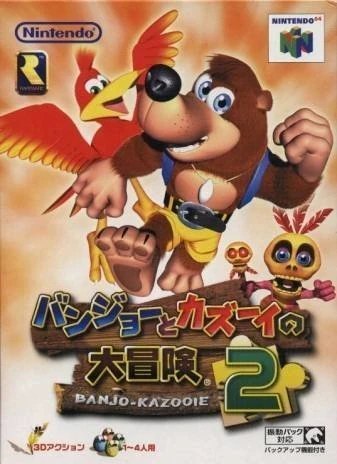
Back, in both languages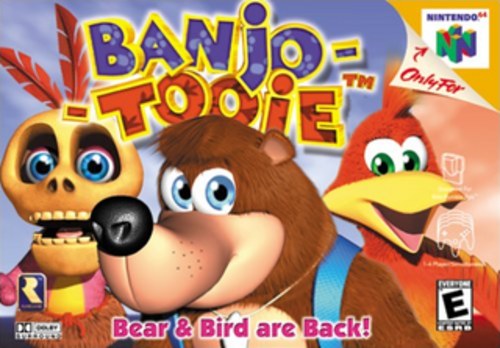
THE MAKING
Started the month the first game shippedDevelopment began in June 1998, directly on the heels of Banjo-Kazooie, and the design brief was expansion in every direction. The worlds interconnect: a train, the Chuffy, carries the pair between levels, and puzzles reach across world boundaries. Banjo and Kazooie can split up and work separately, aiming switches to first-person view. Mumbo Jumbo becomes playable in the field while a new character, Humba Wumba, takes over the transformations. A four-player multiplayer suite rides along. Grant Kirkhope, with twice the cartridge memory for audio, could now crossfade two full MIDI arrangements as the player moved, the vertical-remixing idea from the first game given room to breathe.
The cutting floor is documented with unusual honesty. A whole castle world was dropped, its assets recycled into Cauldron Keep. A mode called Bottles' Revenge, in which a second player possessed an undead Bottles and controlled the enemies against player one, worked rather well by the team's account; it was cut because possessing bosses could not be debugged in time, and the idea later resurfaced in Perfect Dark's Counter-Operative mode. Reviewers praised the scale and the graphics and marked the frame rate down for inconsistency, the tax the ambition paid on 1998 hardware asked to run a 2000 game.
THE DEBT IT PAID
Eggs, by handTooie also inherited the first game's famous unfinished business. Stop 'n' Swop, the cartridge-swapping secret the hardware would not support, is honoured here in miniature: three eggs and the Ice Key hidden inside the game itself, waiting to be found rather than transferred. The full story of why the original plan failed is on this shelf's Stop 'n' Swop page, filed under Banjo-Kazooie, where the tease began.