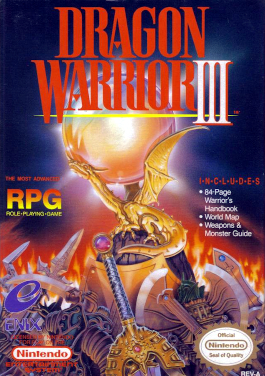
The History of Dragon Quest III
Dragon Quest III reached the Famicom on February 10, 1988, and North America in March 1992 as Dragon Warrior III. It is a prequel: the hero who earns the name Erdrick, whose legend the first two games inherited. It sold 3.8 million copies in Japan, more than any game of its era there, and it is the release that turned a series into a national event.
THE MAKING
Horii perfects the structureHorii said in a 1989 interview that with the third game the developers had perfected the series' game structure: the lone hero of the first game and the fixed party of the second gave way to a party the player builds. The password system of the first two games was dropped for save slots, partly because Horii disliked the long codes players had to memorize. He also kept a policy of removing any feature another game had used first, a rule that finally broke here, when another maker shipped a world map concept first and his team was too far along to change course.
One restraint survived: Horii preferred a silent protagonist, so the player becomes the hero. At one point in the story he was forced to break it, and the hero shouts a single line: "Leave him to us! Run! Quick!"
THE DESIGN
Classes, personalities in waiting, and a world shaped like EarthAt the tavern in Aliahan the player recruits companions and chooses their classes: soldier, fighter, pilgrim, wizard, merchant, goof off, and, for those who earn it, sage. At the temple of Dhama, from level twenty, a character can change class, keeping their spells while their stats halve and their level restarts, so a wizard's mind can be rebuilt inside a soldier's body. The game added a day and night cycle, an arena for betting on monster fights, and a world map that quietly mirrors the real Earth, with Romaly for Rome, Portoga for Portugal, and Jipang for Japan.
Then the design plays its largest trick. Defeating the archfiend Baramos is not the ending. His master Zoma opens a pit into a dark world that is Alefgard itself, the land of the first game, and the hero's reward at the end of it is the title the first game's legend kept invoking: Erdrick, Loto in Japanese. The third game is the first story, told last.
THE EDITIONS
The versions, documentedTHE RECEPTION
Scores, sales, and the dissentFamitsu's readers, polled in 2006, placed Dragon Quest III third among the best games of all time, behind only Final Fantasy X and Final Fantasy VII. GamesRadar ranked it the twelfth best NES game ever made, choosing it over the other Dragon Warrior titles for a job system they called deep and influential.
THE LEGACY
What it left behindThe class system became a staple of the series, and the prequel structure, a legend explained by playing it, is still the series' most retold story. The game's launch day is also the source of Japan's most durable gaming legend, the supposed law against weekday releases. The documented record, Enix's own decision, arrests and all, has its own page in this Library.
The hero of this game, in both his and her forms, reached Super Smash Bros. Ultimate as downloadable content in 2018, officially voiced for the first time.
THE GAME ON THE SHELF
Dragon Quest III · NES