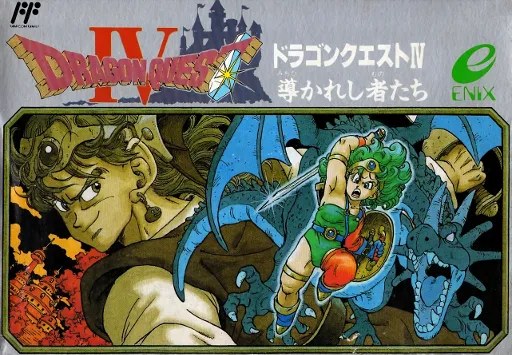
The History of Dragon Quest IV
Dragon Quest IV reached the Famicom on February 11, 1990, and the NES in October 1992 as Dragon Warrior IV. It opens the Zenithian trilogy and breaks its story into chapters, each following a different future companion before the hero's own chapter gathers them. In Japan its first 1.3 million cartridges sold out within an hour.
THE MAKING
Horii collects people instead of thingsHorii has said he wanted something for the player to go around collecting, as the earlier games had crests and orbs, but refused to repeat the trick of gating the ending behind a set count of items. His answer was the mini medal: a collectible with nothing to do with clearing the game, hidden in drawers and jars, which this game also taught players to search. The collecting that matters, though, is people: a soldier, a princess, a merchant, two sisters, each given a full chapter of their own before the hero appears.
The American version was the end of an era twice over. It was the last Dragon Quest localized by Enix America before the subsidiary closed in November 1995, and the last Dragon Quest localized into English at all until Dragon Warrior Monsters in December 1999. Its changes were gentler than its predecessors': the usual religious and violence censorship, new opening and ending graphics, and a casino slightly rebalanced in the player's favor.
THE DESIGN
Chapters, a wagon, and the first TacticsThe first four chapters are short stories with their own economies. The merchant Torneko, Taloon in the NES version, spends his chapter working in a weapon shop, saving for a shop of his own, and raising money to dig a tunnel: a chapter whose only goal is commerce. When the party finally assembles, a wagon lets the player swap members in and out of battle, another series first alongside the casino.
In the final chapter the companions fight under an artificial intelligence system called Tactics: the player sets strategies, damage, healing, conserve magic, and keeps direct control of the hero alone. The system is regularly cited as a precursor of Final Fantasy XII's Gambits, and later Dragon Quest games refined it into per character orders, including the option to take full manual control.
THE EDITIONS
The versions, documentedTHE RECEPTION
Scores, sales, and the dissentFamitsu's readers voted it the fourteenth best game of all time in 2006, and critics kept singling out Torneko's chapter, a stretch of ordinary working life inside an epic, as the game's signature departure.
THE LEGACY
What it left behindDragon Quest IV is the first game in the series to spawn spin-offs. Torneko's popularity carried him into Torneko no Daiboken, Chunsoft's roguelike dungeon games, whose success inspired the entire Mystery Dungeon series. The chapter structure, meanwhile, became the series' boldest storytelling experiment, and its villain Psaro proved popular enough that the remakes rewrote the ending to let him join the party.