The History of Dragon Quest V
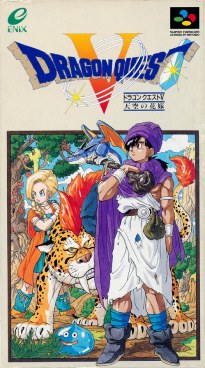
Dragon Quest V (Super Famicom, September 27, 1992), subtitled Bride of Heaven in Japan and known in English as Hand of the Heavenly Bride, follows its hero across roughly thirty years, from his birth in the opening scene to the day his own children take up the quest. Japan formed queues reported at up to three miles on release morning; the game sold over 1.3 million cartridges in a single day, 2.8 million in Japan by 1993, and finished 1992 as Japan's best-selling home video game. It was the first mainline Dragon Quest that North America did not get at the time.
THE MAKING
Enix and Chunsoft's farewellThe series formula held at the top: scenario and design by Yuji Horii, character and monster art by Akira Toriyama, music by Koichi Sugiyama, direction by Manabu Yamana at Chunsoft. It was the first mainline Dragon Quest on the Super Famicom, with the graphics and sound jump the new hardware allowed, and the sprites were deliberately outlined to give the game a manga look.
It was also an ending behind the scenes: completing V marked the point where Chunsoft stepped away from the series to develop its own games independently. The next mainline entry would be made by a different studio, Heartbeat, a handover this Library's Dragon Quest VI page picks up.
THE DESIGN
The life structure, and the monsters joinThe plot is divided into three generations of one family. The hero travels as a small boy beside his father Pankraz, loses him, spends ten years enslaved building a temple, escapes, and is offered a choice the medium had barely attempted: marriage, to his childhood friend Bianca or to the wealthy Nera (the DS remake adds her sister Debora, whom Horii described as a character nobody in their right mind would pick). The hero's wife bears twins, he is turned to stone for eight years, and the Legendary Hero his father spent his life searching for turns out to be his own son.
Mechanically, V introduced the series' most copied idea: defeated monsters may ask to join the party, fighting and leveling beside the human cast. Forty could join in the Super Famicom version, a ceiling the remake notes blame on ROM limits. It was also the first Dragon Quest with a post-game bonus dungeon.
THE EDITIONS
Japan first, the West sixteen years laterTHE RECEPTION
Japan's game of 1992, and a permanent fixture of its pollsWestern critics, meeting it properly on DS, praised the structure and noted the cost: the interface feels archaic and overly simple, several reviews agreed, while the emotional plot more than makes up for it. Gamasutra's judgment on the coming of age theme was the strongest: never has it been executed so magnificently. It is also, on record, Horii's own favorite in the series he created.
THE LEGACY
The collecting game, and the life gameV's two inventions split into two long futures. Monster recruitment became the foundation of the Dragon Quest Monsters spin-off line, and the collecting concept it carried appeared across later franchises, Pokémon and Digimon among them. The life structure had its own firsts: the game is credited as the first known video game to feature a playable pregnancy, and its marriage, children, and generational hand-off remain the series' most retold story.
The story kept being retold literally, too: an eleven-volume manga in the 1990s, and in 2019 a full animated film, Dragon Quest: Your Story, released worldwide on Netflix. In Japan it is not treated as an old game. It is treated as a national novel that happens to be playable.
THE GAME ON THE SHELF
Dragon Quest V · Super Famicom