
The History of Grandia
Grandia began as Game Arts' follow-up to its Lunar games: a boy named Justin, a magic Spirit Stone, and a journey past the wall called the End of the World. It was released first for the Sega Saturn in Japan in December 1997, where it sold 344,554 copies and was voted one of the machine's defining RPGs. The Saturn version never left Japan. The game reached the West only after a PlayStation port in 1999, published in North America by Sony itself. This page covers the Saturn original in full first, as the game's origin, then the port.
THE PLAYSTATION BOX
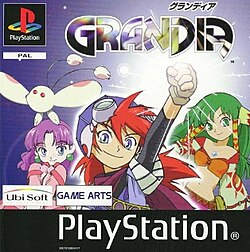
The Saturn box, the version this history treats as the original, was not verified to the Library's standard in this pass and is a named gap. No later port box has been substituted for it.
THE MAKING, ON SATURN
Game Arts after Lunar, 1995 to 1997Grandia was developed by Game Arts over more than two years, beginning after Lunar: Eternal Blue for the Mega-CD, headed by producer Yoichi Miyaji and directors Takeshi Miyaji and Toshiaki Hontani, with much of the Lunar staff, including composer Noriyuki Iwadare. The project was originally intended for the Mega-CD and shifted to the Saturn early in development as Sega abandoned the older platform. Game Arts described its aim on the record: good games rather than market trends, and a compelling story for its existing fanbase. The finished game carries 20,000 frames of animation.
Iwadare called the score a turning point in his career; the main theme, Theme of Grandia, was composed in one night after looking at an illustration for the game, and the music was recorded at Skywalker Sound. The Saturn release, December 18, 1997, came with a pre-order Limited Edition carrying a fold-out cloth world map and a mini radio drama disc; a Memorial Package with new booklet art and a lower price followed in November 1998.
THE DESIGN
The IP bar and the cancelling blowGrandia's environments are 3D maps explored with a fully rotating camera, with 2D sprite characters; rotating the view to find hidden passages is part of the exploration. Its combat runs on the IP bar: icons for every fighter drift toward the Command segment, and a strike landed while an enemy is charging can cancel that enemy's attack outright, a timing system the series kept. Monsters are visible on the field, so contact from behind grants a preemptive strike, and the same courtesy runs in reverse.
Characters grow by using things: weapon and magic skill levels rise with repeated use, and leveling a skill pays permanent stat points, which encourages rotating weapons and elements rather than settling. The story's tone is the design's other half: an adventure serial about a boy who refuses to believe the age of adventure is over, played warm rather than grim.
THE EDITIONS
Saturn, then PlayStation, then remasterTHE RECEPTION
Acclaim on both machinesThe sales record splits by machine and country. The Saturn original sold 181,219 copies in its first week and 344,554 in Japan, the fourth best-selling Saturn title of 1997 in Japan, with unusually heavy North American imports for a game with no Western release. The PlayStation version sold about 97,460 copies in its first three weeks in Japan, a smaller second life at home, while finally giving the game its Western audience.
THE LEGACY
The battle system outlived the port warGrandia's combat mechanics were carried into the series' sequels, and Eurogamer's 2007 retrospective judged the battle system one few later games have rivaled. The Saturn to PlayStation journey is itself the collector's story: a Japanese Saturn flagship that Western players first met as an import legend, then as a Sony published PlayStation game, then, twenty years on, as a remaster that needed both versions to be made whole. Why the game changed machines is taken up on its own question page, linked below.