
The History of Illusion of Gaia
Illusion of Gaia (Super Nintendo, 1993) sends a boy named Will across a fantasy Earth of real places, Incan ruins, the Nazca Lines, Angkor Wat, the Great Wall, the Egyptian pyramids, to stop a comet that is not a comet. In Japan it is Gaia Gensoki; in PAL territories it was renamed Illusion of Time. It is the middle game of the fan named Quintet trilogy and, unusually for this studio, the one Nintendo itself published to the West.
THE BOXES
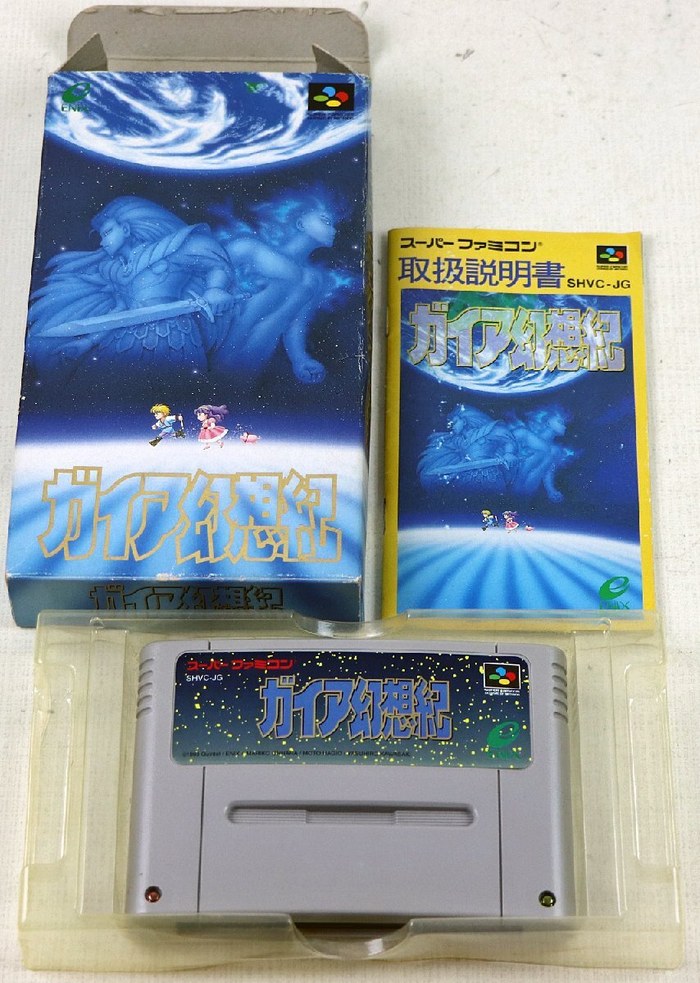
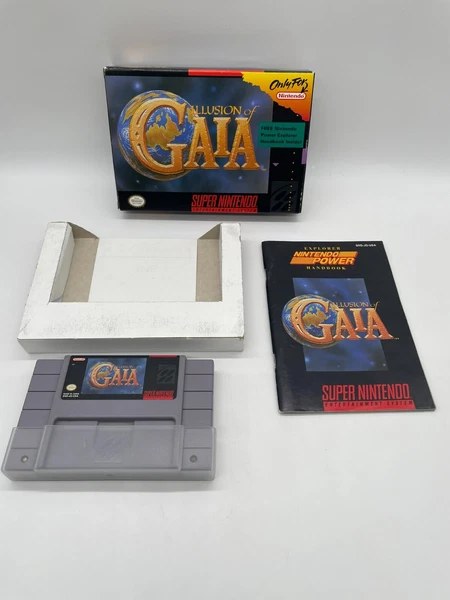
Both files are photographs of complete packages rather than flat scans, and the American file is below the Library's working width; both are flagged as swap in upgrades in this build's notes. The PAL box, as Illusion of Time, is a third design and is not staged here rather than borrowed from a render.
THE MAKING
A manga legend and a science fiction novelist walk inThe credits are the story. Masaya Hashimoto directed and Tomoyoshi Miyazaki designed, as usual, but the character designs are by Moto Hagio, one of the foundational artists of shojo manga, and the story contribution is by Mariko Ohara, a science fiction novelist. The score is by Yasuhiro Kawasaki. Enix published in Japan; Nintendo published in North America and PAL territories, which bought the game a Nintendo Power handbook, a T-shirt bundle offer, and marketing weight no other Quintet title received in the West.
A leaked pre-release English build survives in the record under the title SoulBlazer: Illusion of GAIA, with Will named Tim and Kara named Karen. That single title screen is the strongest physical evidence that the trilogy connection was once more than a fan theory, and it is presented here as exactly that: a prototype artifact, not a published fact. The final American logo was redesigned, and the prototype's Nintendo credit is absent because it predates Nintendo's publishing deal.
THE DESIGN
No experience points, no shops, no going backGaia strips the RPG toolkit down. There are no experience points: clear every enemy in a room and Will earns a jewel that permanently raises attack, defense, or health. There is no currency and no equipment system, and the only healing item, herbs, is scarce. Cleared areas mostly cannot be revisited, so the game's one side quest, collecting all 50 Red Jewels, can be failed permanently by walking past one. Will transforms at Dark Spaces into the knight Freedan and, later, into Shadow, a solid being of energy; the three forms share one life and divide the puzzles between them.
The setting does the grandeur instead. It is the Age of Exploration, roughly the 16th century, and each ruin holds a Mystic Statue and a piece of the truth: the comet is an ancient weapon from the last Blazer War, and its past approaches have repeatedly knocked evolution off course. At the Tower of Babel, Will and Kara are revealed as the Dark and Light Knights, and unite as Shadow to loose the firebird.
THE EDITIONS
Three names, and a censored middleTHE RECEPTION
Acclaim, with the dissent keptQuintet reported 650,000 copies worldwide, the studio's biggest total on this shelf: 200,000 in Japan, 300,000 in North America, the strongest American sale Quintet ever had, and 150,000 in Europe. Nintendo's publishing muscle is the obvious difference, and the sales split is the evidence.
THE LEGACY
The middle chapter, at its documented weightGaia is routinely called the second part of the unofficial trilogy, and just as routinely the record qualifies it: Enix USA producer Robert Jerauld stated there is no connection in the universe between Soul Blazer and Gaia. Both things belong on the page, the fan grouping and the producer's denial, because the tension between them is the actual history. IGN ranked Gaia 74th on its Top 100 SNES Games list, two places above the game it is supposedly a sequel to.