
The History of Majora's Mask
Majora's Mask (Nintendo 64, 2000) is the direct sequel to Ocarina of Time and the series' strangest main entry. Months after saving Hyrule, Link is ambushed by a Skull Kid wearing a stolen mask, cursed into a Deku Scrub, and dropped into Termina, a parallel land with three days left before its moon falls. The whole game runs on that loop: three days, reset by the Song of Time, and 24 masks that change what Link is. It was built in fifteen months on its predecessor's engine, sold 3.36 million copies, and grew from a well reviewed sequel into the series' defining cult game.
HOW IT WAS MADE
Nintendo EAD, 1999 to 2000It began as a remix. Nintendo planned Ura Zelda, a reworked edition of Ocarina of Time for the 64DD, and Eiji Aonuma, who had designed that game's dungeons, was unenthusiastic about designing them again. Miyamoto challenged the team instead: make a new game, on the existing engine and graphics, in one year. A smaller team, led by Aonuma and Yoshiaki Koizumi with Miyamoto supervising, finished in fifteen months by reusing Ocarina's assets. The schedule meant serious crunch, and the writers vented by writing complaints about overwork into the script itself.
The loop came from Koizumi, who had been designing a repeatable cops and robbers game where each play could go differently. Folded into Zelda, it became the three day cycle: compact data, deep play. It was a full week early on, and was cut to three days because seven was too much for players to hold in memory. Aonuma cited the 1998 film Run Lola Run as an inspiration for the time loop, and Koizumi said the falling moon came from one of his dreams. Art director Takaya Imamura built the name Majora from his own surname and the word jura, from his favorite film, Jurassic Park. Where Ocarina's Hyrule drew on medieval Europe, Termina drew on Southeast Asia, and its borrowed character models were deliberately set in a sadder register: Aonuma reasoned that Ocarina's players had grown up a little, and could be moved by sadness and regret. The Anju and Kafei wedding quest, the game's signature side story, sets a wedding against the falling moon on purpose.
Technically it is Ocarina's engine, upgraded, and it requires the 4MB Expansion Pak, one of only two Nintendo 64 games to do so. The extra memory bought longer draw distances, better lighting and textures, and more characters on screen, which is why Termina needs no fog and no cardboard panoramas to hide its edges. Koji Kondo wrote the score with contributions from Toru Minegishi, describing its sound as an exotic Chinese opera, and Clock Town's theme changes across the three days, quickening as time runs out. The two disc Japanese soundtrack, 112 tracks, followed on June 23, 2000.
THE RELEASE
April to November 2000The Covers
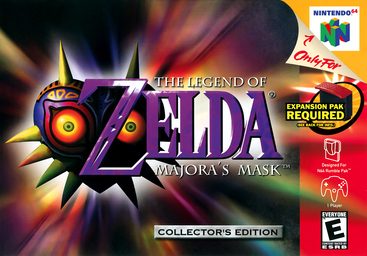
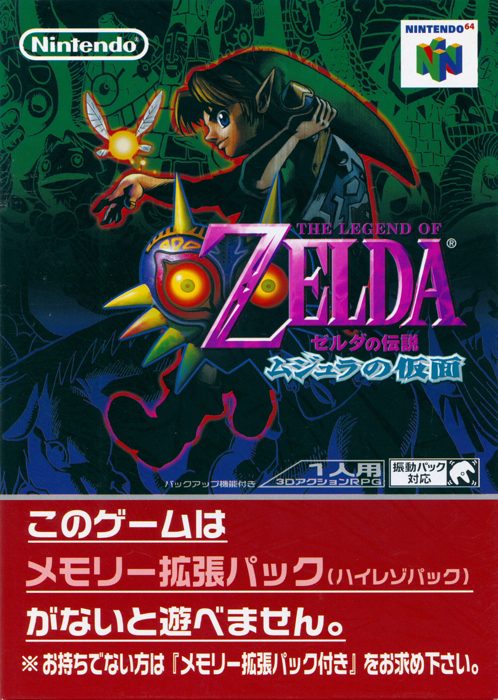
The game surfaced in May 1999, when Famitsu reported a long planned Zelda expansion for the 64DD in development, and it was playable at Nintendo Space World on August 27, 1999, clock, timer and mask transformations already in place. The final title was announced in March 2000, backed by an 8 million dollar American marketing campaign. It launched in Japan on April 27, 2000, on North America on October 26, 2000, on a gold cartridge, and in PAL regions on November 17. Japan sold it in standard, box set and Memory Pack bundle forms. By the end of 2000 it had sold 601,542 copies in Japan and 1,206,489 in the United States, where it was the fourth best-selling game of the year.
HOW IT WAS RECEIVED
Acclaim, with the clock dividing peopleElectronic Gaming Monthly gave it a perfect 10 and Edge a 9. Critics praised the three day cycle as bold and innovative, comparing it to Groundhog Day, and praised the Bombers' Notebook, which tracks the schedules of Termina's people, and the transformation masks. Edge called the interweaving of the townspeople's quests a remarkable achievement, and several reviewers judged the game equal or superior to Ocarina of Time in places, while noting it broke less new ground. At the 4th Annual Interactive Achievement Awards it won Console Action/Adventure and Game Design.
WHAT IT LEFT BEHIND
The cult of the moonThe game returned on GameCube in 2003 inside The Legend of Zelda: Collector's Edition, and Grezzo's enhanced remake, Majora's Mask 3D, arrived on the Nintendo 3DS in February 2015. Its reputation kept climbing after that. It places consistently on greatest games lists, and retrospective writing treats it as a landmark: Polygon's Danielle Riendeau called it the most innovative Zelda on a structural level, a game that moves the focus from the chosen hero to the people Link meets, and later games including Outer Wilds have been linked to its influence.
The fifteen month constraint is now read as the cause, not the cost. Reused models in a sadder world, a clock that takes things away, side stories about ordinary people facing an end they cannot stop: the limits forced the design, and the design is what lasted. Of the three games in this gallery, it is the one whose standing today is highest relative to the standing it was given at launch.
THE QUESTIONS
Majora's Mask, in the archiveThe archive holds no standalone question or guide pages for Majora's Mask yet. This history is its first door, and the gallery below holds its two boxes. The wider Zelda shelf, its books and censuses, lives in the archive at the foot of this page.