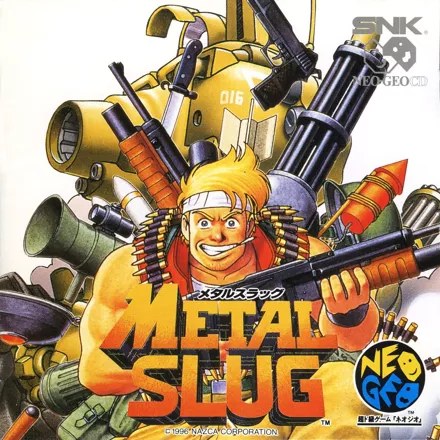
The History of Metal Slug
Metal Slug (Neo Geo, April 19, 1996) was developed by Nazca Corporation and published by SNK. It follows Peregrine Falcon soldiers Marco Rossi and Tarma Roving in 2028, fighting a coup by General Donald Morden's Rebel Army across six missions of forests, garrisoned cities, snowy valleys, canyons, and bases, freeing prisoners of war and climbing into the SV-001 and SV-002 tanks that give the game its name. SNK was so taken with Nazca's work that it acquired the studio in 1996, the year the game shipped.
THE MAKING
Irem veterans, a new company, an old craftNazca was formed by staff who had left Irem, where the same hands had made arcade shooters with a similar presentation, including In the Hunt and GunForce II. Takashi Nishiyama, SNK's own head of development and the creator of Street Fighter and Fatal Fury, produced; Kazuma Kujo and Meeher designed; artists including Akio Oyabu, Kazuhiro Tanaka, and Takeshi Okui drew the pixel art; and Takushi Hiyamuta, credited as Hiya!, composed the score. The stated concept was a simple yet exciting side scrolling shooter with an easy control scheme: one joystick and three buttons. The visuals took inspiration from the works of Hayao Miyazaki, a debt the game's soft, detailed, comic war makes visible in every frame.
The first playable version was a different game: slower, darker, and built around the tanks, with players controlling the SV-001 and SV-002 prototypes through shorter, simpler missions, crewed in the early plot by Regular Army members Phil Gene and Michiko Nakajima. Location test audiences responded poorly, and the project was heavily overhauled: the soldiers stepped out of the tank, platform elements were added, and SNK asked for the game to be lengthened to make it more attractive to console players. That rescue is documented on its own page: was Metal Slug originally a tank only game?
THE GAME
Six missions, one hit, endless jokesThe finished game is a run and gun in the Contra line with a comedian's timing. Enemies are caught sunbathing, roasting food over fires, and chatting when the player arrives, and much of the scenery is destructible, hiding weapons and bonuses. A knife handles close work, contact with an enemy does not kill, and a single bullet, a collision, or a fall does. Freed prisoners pay out random items and weapons, and the end of mission bonus counts them, which turns every stage into a rescue run performed under fire.
THE EDITIONS
Arcade first, then everywhere SNK could put itTHE RECEPTION
Praise for the art, complaints about the lengthThe game was later included in the book 1001 Video Games You Must Play Before You Die, and its success started a franchise of sequels, a remake, and spin-offs, beginning with Metal Slug 2 in 1998. The series outlived its maker: when the original SNK collapsed, Metal Slug 4 was produced under license by the Korean company Mega Enterprise, a handoff documented on the bankruptcy page. The shelf this game sits on, machine and all, is the history of the Neo Geo.
THE GAME ON THE SHELF
Metal Slug