
The History of Robotrek
Robotrek (Super Nintendo, 1994), Slapstick in Japan, is the odd one out on this shelf on purpose: a self described comedy RPG for a younger audience, in which the protagonist never fights at all. He invents up to three robots, programs them, equips them from scrap, and sends them out in capsules to fight for him, two years before Pokemon made that shape famous.
THE BOX
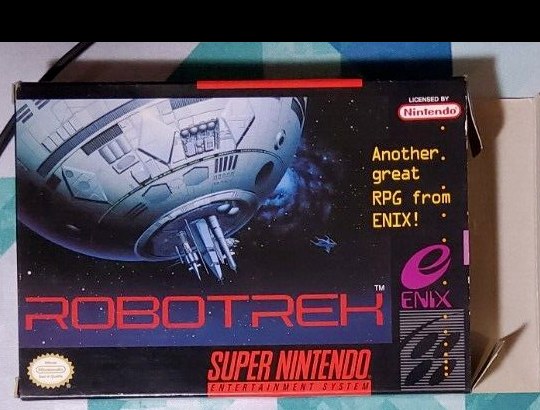
The Japanese Slapstick box is not staged here: no scan of it cleared this build's verification, and a candidate image that arrived labeled as the Japanese package proved on viewing to be a different Quintet game's box and was rejected rather than borrowed. The gap is named, not filled.
THE MAKING
Three years of concept, eighteen months of buildMasaya Hashimoto directed; Shinji Futami, promoted after assisting on ActRaiser's overseas marketing, produced; Reiko Takebayashi was chief designer and scenario writer, and went on to work on Terranigma's scenario; Shigemi Kita was main programmer. The original concept predated release by three years and development took a year and a half, with the battle system rethought and recoded several times. Audio was handled by Ancient: Ayako Yoda composed, and Yuzo Koshiro is credited as sound producer. Artist Koji Yokota designed the robots and was briefed to make them look retro, or old fashioned.
Takebayashi's stated theme was nurturing your own creation: the early model had the player's robots helping townspeople with daily life and being rated for it, before an army of villains was added and expanded into the finished plot. The creation theme from the serious games is still there, wearing a clown nose.
THE DESIGN
Invention as the whole economyOn the planet Quintenix, the Hackers are hunting the Tetron, a stone that lets its holder see past and future and travel through time. The hero, son of the famous inventor Dr. Akihabara, answers with engineering. Robots are built and customized in body color, name, equipment, and special attacks, with Program Points assigned by the player rather than the game. Equipment is invented by combining items in the invention machine, powered by a family of Scraps, Scrap 1 through 10 plus A and B; combining a weapon with its own type raises it through nine levels. Only one robot fights at a time against up to three enemies, switching costs a turn, and experience arrives as Megs of Data.
THE EDITIONS
Two releases, at the end of Enix AmericaTHE RECEPTION
Average scores, and the dissent kept both waysQuintet reported just 45,000 copies in Japan and 20,000 in North America. Former Enix America producer Robert Jerauld speculated the causes were a lack of advertising and an oversaturated console market. The numbers, not the reviews, are why this is the shelf's scarce game.
THE LEGACY
The predecessor nobody cites firstNext Generation credited Robotrek as a predecessor to the core idea of Pokemon: the protagonist does not fight, he sends out his creatures, kept in capsules outside battle, a resemblance to Poke Balls that Hardcore Gaming 101 and RPGamer have also noted. Writers at The Verge and Hardcore Gaming 101 have further suggested it may have partly inspired Robopon, the robot collecting series that began in 1998; that step is a suggestion in print, not a documented credit, and it is labeled as such here. Retrospectively the verdict splits: 1Up's Todd Ciolek called it one of Quintet's few SNES era missteps, Jeremy Parish called it weird yet pretty solid, and GamesRadar counted it among the era's strong second stringers.