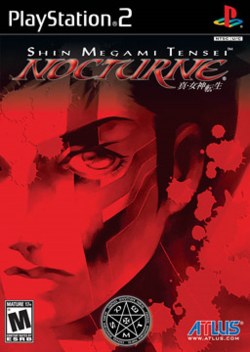
The History of Shin Megami Tensei III: Nocturne
Shin Megami Tensei III: Nocturne (PlayStation 2, 2003) was the main series' return after nine years: the world ends in the first hour, and what remains is a sphere of ruined Tokyo where demons recruit, philosophies compete to design the next world, and one schoolboy, remade as the half demon Demi-fiend, holds the casting vote. It was the first mainline Shin Megami Tensei the West ever received, and it received the expanded edition, with a guest whose presence became a legend of its own.
THE MAKING
A wider audience, a harder gameThe game was conceived after Shin Megami Tensei II and Shin Megami Tensei If... were finished, then delayed while the team worked out what a new main entry should be, including a deliberate aim to appeal beyond the series' existing audience. Kouji Okada produced, Katsura Hashino directed, Kazuma Kaneko designed the demons and characters, and Shoji Meguro led a score that pays homage to the series' earlier music through 1980s styles.
Where Shin Megami Tensei II went science fiction, Nocturne returned to a contemporary setting, and the team rebuilt its presentation for the new hardware: the camera moved from first person to third, and a cel shaded style was chosen to set the game apart from its contemporaries. The inspirations the team worked from included Gnosticism, Mahayana Buddhism, and modern popular culture.
THE DESIGN
The Press Turn and the ReasonsAfter the Conception, Tokyo becomes the Vortex World, and every survivor with a following is building a Reason, a philosophy the reborn world would run on. The Demi-fiend's own nature is set by the Magatama he ingests, parasites that grant skills and reshape his strengths and weaknesses. Which Reason wins, or whether any of them does, is the game's real plot.
Battle runs on the Press Turn system, the series' defining mechanism from this game onward: each side holds a stock of turns, hitting a weakness or landing a critical earns more, and missing or striking a resistance throws turns away, so every action is priced in actions. The party is built by negotiation and fusion: demons are talked into joining mid battle, then fused together at the Cathedral of Shadows into stronger demons that inherit their parents' skills.
THE EDITIONS
The original, Maniax, and the Chronicle swapTHE RECEPTION
Praised, feared, and reprintedTHE LEGACY
The series' Western founding documentNocturne established the terms on which the West would meet Megami Tensei: the Press Turn economy, demon negotiation and fusion, Kaneko's demon designs, and endings decided by philosophy rather than by a final boss. Persona's later Western rise happened in a market this game had already taught to read Atlus.
And then there is the sticker. The Maniax box's guest became the most durable joke in the series' history, until Atlus itself used the line in its own promotion for the HD Remaster's Dante content. Why Dante is in this game at all, a staff suggestion, a film pitch to Capcom, and a character designer traded in return, has its own page in this Library.
THE GAME ON THE SHELF
Nocturne · PS2