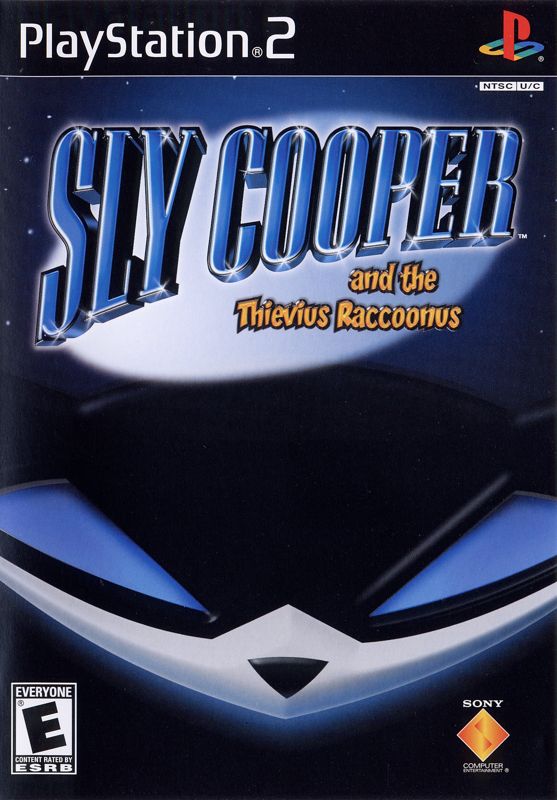
The History of Sly Cooper and the Thievius Raccoonus
Sly Cooper and the Thievius Raccoonus (PlayStation 2, 2002) was Sucker Punch Productions' second game and the stylist of the PlayStation 2 mascot trio: a stealth platformer rendered to look like a hand drawn animated film, in which the hero falls to a single hit and every ledge worth using glows blue. It scored an 86 on Metacritic, won industry awards for its animation and art direction, and sold on the strength of a look no other game on the shelf shared.
THE MAKING
Three years after RocketSucker Punch's first game was Rocket: Robot on Wheels (1999) for the Nintendo 64. Sly Cooper was conceived shortly after Rocket was completed and developed for three years, with art assets built in Alias Maya. Producer Brian Fleming named the rendering style toon shading: detailed, painterly backgrounds behind foreground characters shaded like the cels of an animated film, so the game reads as a moving illustration, one step away from a flattened graphic style. Fleming's own comparison was to classic animation, where simply shaded, outlined characters play in front of rich painted scenery, and Sly applies a different rendering approach to characters than to backgrounds on purpose.
The art team collected hundreds of photos and drawings of places that looked like the worlds they wanted to build. The characters went through six or eight major revisions each before their designs settled. Performance had a guardian: at least one engineer worked on nothing but frame rate for the entire development, so the illustrated look would never cost the game its smoothness.
THE DESIGN AND THE MUSIC
One hit, blue sparks, adaptive jazzSly is a master thief recovering his family's stolen book of techniques, one page at a time, from the Fiendish Five. The design tension is deliberate: Sly is defeated by one hit, so the game teaches stealth through the environment itself. Blue sparkles, Sly's thief senses, mark the pipes, ledges, and points where context sensitive moves can be triggered. Clue bottles hidden in each area open vaults holding pages of the Thievius Raccoonus, and each page teaches a new move, so the book the villains stole is also the game's skill tree.
Composer Ashif Hakik built the score on the artwork and the locales, naming his influences on the record: Yoko Kanno's work on Cowboy Bebop, Henry Mancini, and Carl Stalling. The music is interactive, an engine that treats each level's gameplay as the starting point: the score rises in volume and pace when Sly attacks or is spotted, and settles again when the disturbance passes. Sneaking, in this game, has a tempo, and being caught changes it in real time.
THE EDITIONS
Three names for one thiefTHE RECEPTION
Praise, with the dissent keptThe game sold over 400,000 copies in its first year and 800,000 in the United States by July 2006, the smallest seller of this gallery's three Sony heroes and the one with the longest critical afterlife: GameSpy placed it among the most underrated games of its era, and Sly is routinely named a PlayStation mascot alongside Jak and Ratchet, the three studios' friendship written into the record.
THE GAME ON THE SHELF
Sly Cooper and the Thievius Raccoonus · PlayStation 2