
The History of Soul Blazer
Soul Blazer (Super Nintendo, 1992) is where Quintet's creation theme becomes a system. A king has sold every soul in his kingdom to a demon, one gold piece each. You are the Master's servant, sent down to empty dungeons lair by lair, and every lair you destroy frees a soul and rebuilds a piece of the town above it, a house, a person, a dolphin, a talking tulip at a time. In Japan it is Soul Blader.
THE BOXES
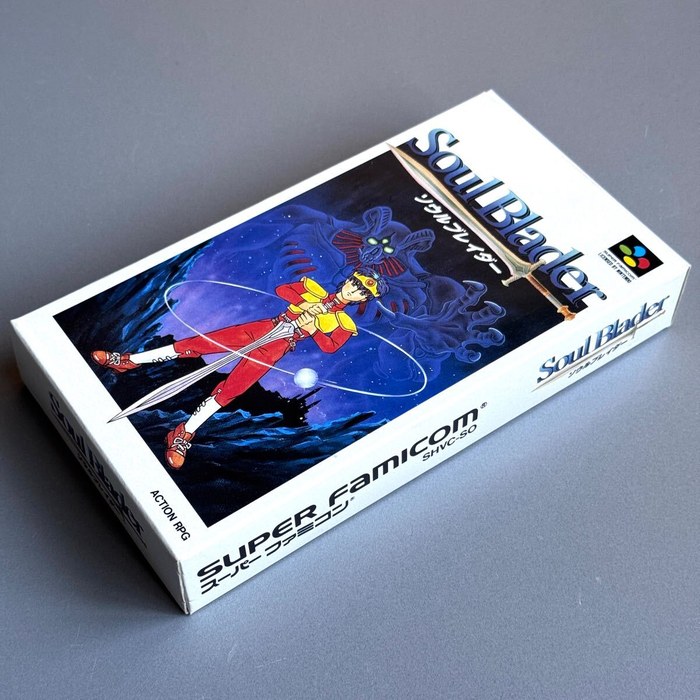
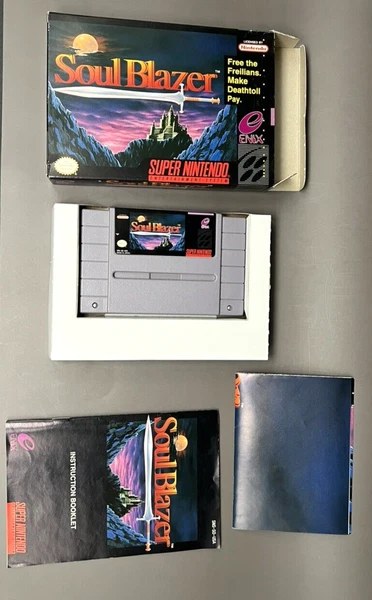
The American file is a smaller photograph than the Library's working standard and is flagged as a swap in upgrade in this build's notes. The Japanese box was never the same picture: different hero pose, different mood, same demon.
THE MAKING
The Ys pair, second time outMasaya Hashimoto directed and programmed; Yasuyuki Sone produced; Tomoyoshi Miyazaki wrote the scenario, assisted by Tatsuo Hashimoto. The score is by Yukihide Takekawa, released on album by Apollon in Japan on February 21, 1992, three weeks after the game. The story machinery is pure Quintet duality: The Master who creates against Deathtoll who buys destruction wholesale.
The bargain at the plot's center is unusually specific. King Magridd imprisoned the inventor Dr. Leo and forced him to build a machine to summon Deathtoll, who offered one gold piece for every soul in the kingdom. The king, advised by his queen, accepted, and was imprisoned himself. Leo's daughter Lisa is the hero's human anchor, and Leo, once freed, gives his life to stop the queen, who is still trying to bargain.
THE DESIGN
Resurrection as a progress barProgress alternates between two states of the same place. Below, a dungeon of monster lairs; above, an empty field. Destroy a lair and a soul is liberated and reincarnated, and the town reconstructs around the returnees, who repay you with advice, items, and small human scenes the genre rarely stopped for. Clear the boss holding each town head's soul and the region is done. Six regions yield six colored stones that open the World of Evil, and three sacred artifacts summon the phoenix for the final fight.
The ending mirrors ActRaiser's, softer. Returned to heaven, the hero misses being human, and the Master sends him back on one condition: no memory of any of it. He wakes in Grass Valley, Lisa recognizes him, and they walk off to become friends again from the beginning.
THE EDITIONS
Three releases, then silenceTHE RECEPTION
Acclaim, with the dissent keptQuintet reported 295,000 copies worldwide: 200,000 in Japan, 70,000 in North America, and 25,000 in Europe. Acclaim and sales pointed in opposite directions, the pattern that defines this studio's whole catalogue.
THE LEGACY
First of a trilogy that officially is not oneFans and journalists group Soul Blazer with Illusion of Gaia and Terranigma under rotating names: the Quintet Trilogy, the Gaia Trilogy, the Heaven and Earth Trilogy, the Soul Blazer Trilogy. All of those names are fan names. The documented counterweight, printed here at its proper weight: former Enix USA producer Robert Jerauld said there is no connection between Soul Blazer and Gaia, and that Soul Blazer is instead related to ActRaiser, a sort of prequel to it. IGN still ranked the game 76th on its Top 100 SNES Games list, calling it bold and memorable, trilogy or no trilogy.