
The History of Suikoden II
Suikoden II (PlayStation, 1998 in Japan) took the first game's structure north into a new war: two childhood friends, Riou and Jowy, each take half of the Rune of the Beginning and are pulled to opposite sides of Highland's invasion of the City-States of Jowston. It was, on release, commercially successful in Japan and a limited print run in the West, reviewed respectfully and then largely passed over. Since the 2010s it has been re-ranked, repeatedly, among the greatest games ever made. Both halves of that record are documented on this page.
THE AMERICAN BOX
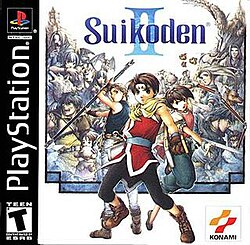
The Japanese box was not verified to the Library's standard in this pass and is a named gap, not a substitution. The Western print's scarcity is itself documented: the game saw a limited print run in the West, and the lackluster initial response prevented a reprinting.
THE MAKING
Murayama writes the war himselfWith the first game a success, the sequel was green-lit. Murayama read the fan letters and concluded that the first game's selling point was its story, so story became the second game's main focus; the scenario was conceived after the first game was finished and was mostly written by Murayama himself. Designers Fumi Ishikawa and Junko Kawano returned, and Miki Higashino composed again, this time with Keiko Fukami.
The refinements were structural. War battles moved from the first game's system to a grid and unit based tactical system; characters could equip three runes at once instead of one; a party inventory and a dash button smoothed the running around; and loading a completed save from the first game let returning characters enter at higher levels with improved weapons, with the first game's hero himself recruitable. The cooking minigame, judged against an Iron Chef style contest, is the famous one among a shelf of diversions.
THE DESIGN
Two halves of one runeThe Rune of the Beginning governs conflict itself, and the game builds its tragedy into the magic system: its two halves, the Bright Shield and the Black Sword, steer their bearers toward each other. Around that spine the 108 Stars structure deepens: unite attacks pair specific characters, massive battles can wound or permanently kill the recruits the player has spent hours gathering, and the castle headquarters grows from an empty ruin at North Window into a small town.
The antagonist for most of the game, Prince Luca Blight, is written as open brutality rather than misunderstood villainy, and the story's turn, when it comes, is political: the war outlives the madman, and the friend on the other throne will not make peace. Multiple endings branch on the player's choices, and the complete ending is gated behind recruiting all 108 Stars.
THE EDITIONS
One print run, then downloadsTHE RECEPTION
Respectful then, canonical nowThe reversal is a matter of dated lists, not nostalgia asserted here: Polygon's 500 best games, IGN's Top 100, Hardcore Gaming 101's 200 best, and Game Informer's reader voted Top 300 all place it; USgamer's Kat Bailey called it the best PlayStation 1 RPG ever in 2019, and its own retrospective ranked it fifth among all RPGs. The full question of how the afterlife happened is taken up on its own page, linked below.
THE LEGACY
The best Suikoden, by consensusLater series entries never displaced it: the critical consensus recorded across the 2010s names Suikoden II the best of the Suikoden games and one of the best console RPGs outside the Square Enix canon. Its two distribution facts, a small Western print run and a fifteen year wait for a download reissue, made the original North American disc one of the era's defining collector objects in the meantime, which is the market half of the cult story and is logged as a signal with this build.