
The History of Super Mario RPG
Super Mario RPG: Legend of the Seven Stars (Super Nintendo, 1996) was the first role-playing game in the Mario series, and it was not made by Nintendo alone. Square, then at the height of its 16-bit powers, developed it under producer Shigeru Miyamoto, and the result married Square's turn-based battles to Mario's jumping, hidden blocks, and humor. It was the final Mario game on the SNES, one of the last Square games for Nintendo hardware for years, and the seed of two successor series.
THE BOX
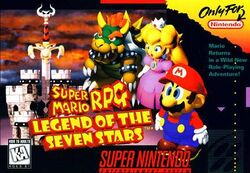
The game was not released in PAL regions on the SNES. Nintendo cited the work of optimizing it for PAL televisions and translating it into multiple languages, and Europe first received it on the Wii Virtual Console in 2008. The Japanese box, not staged here, drops the subtitle and lines the cast up on white. A larger scan of either box remains a swap-in upgrade.
THE MAKING
A meeting in early 1994According to Nintendo's Yoshio Hongo, the game came out of two wishes meeting: Miyamoto wanted an RPG built on Mario, and Square wanted an RPG that could perform better outside Japan than its previous games. Development began in early 1994 after a business meeting between the two companies, and was directed by Chihiro Fujioka and Yoshihiko Maekawa.
The team's standing worry was making, in their own framing, a normal RPG that simply substituted in Mario characters. Meetings with Miyamoto steered the design away from standard RPG weapons; swords and the like were dropped as a poor fit for Mario, with the hammer kept at Miyamoto's insistence. In their place came movement: Mario jogs in eight directions, jumps between levels of an isometric world, and finds enemies visible on the field rather than by random encounter.
The graphics took over a year of work by teams at both companies, built with advanced computer modeling, special lighting for shadows and reflections, and pre-rendered sprites. The cartridge carried Nintendo's SA-1 chip, an extra microprocessor that raised clock speeds and memory handling; Super Mario RPG is one of only seven SNES games released outside Japan to use it. Yoko Shimomura composed the score, arranging Koji Kondo's Mario themes alongside three tracks drawn from Nobuo Uematsu's Final Fantasy IV music, and later called the score a turning point in her career.
THE DESIGN
Timed hits and a party of fiveThe battle system is Square's turn-based structure with one decisive addition: action commands. A timed button press during an attack, a special move, a defense, or an item use amplifies its effect. The mechanic became a mainstay of every later Mario RPG.
The party grows to five: Mario; Mallow, a cloud boy who believes he is a tadpole; Geno, a doll possessed by a spirit of the Star Road; Princess Toadstool, a healer; and Bowser, whose own army has deserted him and who joins pretending Mario has joined the Koopa Troop. The quest repairs the shattered Star Road, whose seven star pieces the Smithy Gang scattered when the giant sword Exor crashed into Bowser's castle, so that wishes can be granted again.
THE EDITIONS
Two launches, then a long wait for EuropeTHE RECEPTION
Acclaim, with the dissent keptThe dissent is on record too. RPGamer's Derek Cavin found most of the battle mechanics unoriginal and the storyline lacking unity; AllGame's Skyler Miller noted the battle music turning monotonous over many fights and little left to discover on a second run; 1UP.com judged the characters too childish for older gamers. Next Generation answered from the other side: complex enough for veteran RPG players, simple enough not to alienate newcomers.
THE LEGACY
No sequel, two dynastiesThere is no direct sequel. What followed instead were two series built on its conventions: Paper Mario, announced for the 64DD under the working title Super Mario RPG 2 before becoming the Nintendo 64 game, and Mario and Luigi, made by Fujioka and Maekawa's later studio AlphaDream with Shimomura composing. Both keep the timed action commands, the shared party resource in place of individual magic pools, and, in Paper Mario's case, the collection of seven stars.
Geno, a character from this one game, stayed a fan favorite for decades on the strength of it; Masahiro Sakurai added him as a Mii Fighter costume in Super Smash Bros., citing his arm cannon as a natural fit. The original sits on the Super NES Classic Edition in all regions, one of 21 built-in games.