
The History of Terranigma
Terranigma (Super Nintendo, 1995) is Quintet's creation epic: a boy named Ark unfreezes his village by raising the continents of a dead world, then resurrects plants, birds, animals, and humanity itself, and slowly learns who has been giving his orders. Enix published it in Japan as Tenchi Sozo. Nintendo published it in Europe and Australia. It was never released in North America, and for over thirty years it was never re-released anywhere. Those two facts are inseparable from what the game is now.
THE BOX
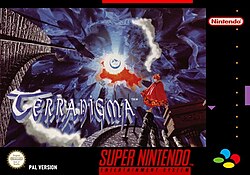
There is no North American box, and there never was. The Japanese Tenchi Sozo box exists but is not staged here; the PAL box is the artifact this game's Western history turns on, including its burden: the PAL release runs at 50Hz, slower than the 60Hz original. The staged file is 250px wide, below the Library's working standard, and is a swap-in upgrade when a larger scan is verified.
THE MAKING
Quintet, commissioned by EnixPublisher Enix commissioned Quintet as a subcontractor and chose an action RPG for strategic reasons: Quintet's experience in the genre and the warm Japanese reception of its earlier games, ActRaiser, Soul Blazer, and Illusion of Gaia, the two games Terranigma is grouped with as an unofficial trilogy. Director and designer Tomoyoshi Miyazaki, Quintet's founder, wrote the script, with scenario by Reiko Takebayashi; manga artist Kamui Fujiwara designed the characters; Tatsuo Hashimoto created the cover art and the background images for the resurrection scenes.
Miyazaki set the theme deliberately against genre habit: creation as a contrast to the destruction of enemies in other action games, meant to make players imagine the effects of their own actions. The music was composed by Miyoko Takaoka and Masanori Hikichi; Yuzo Koshiro, ActRaiser's composer, contributed the laboratory track uncredited, a fact he confirmed himself decades later.
THE DESIGN
Resurrection as the progression systemThe world is a hollow sphere, Lightside surface and Darkside underworld, growth against decline, called God and Devil by the humans who came later. Ark's journey is structured as literal world-building: five towers raise the continents; then plants return, then birds and wind, then animals, then mankind; then, in the third chapter, civilization itself, as Ark expands towns and midwives inventions, including encounters with figures modeled on real inventors and explorers. Experience, levels, and gear sit on top of a game whose real progress bar is the history of life on Earth.
Combat is real-time and positional: running, jumping, and standing attacks strike differently, projectiles can be guarded, and there are no magic points. Spells are one-use items, rings and medals bought by exchanging Magirocks at magic shops, which return to Magirocks when cast. Reviewers then and since have called that magic system the design's weak joint, cumbersome and easy to ignore, inside a game praised for everything around it.
THE EDITIONS
Japan and PAL, preciselyWhy America was skipped, and why the wait lasted thirty years, is this shelf's question page: Why was Terranigma never released in North America? One irony belongs here: the English script used in Nintendo's European and Australian releases was translated with Nintendo of America's own people among its translators, Dan Owsen and Nob Ogasawara included. The words existed. The American box never did.
THE RECEPTION
Acclaim, with the dissent keptThe dissent: difficulty was criticized in several contemporary reviews, Mega Fun faulted the official strategy guide for revealing the puzzles, and retrospective reviewers at RPGamer and Hardcore Gaming 101 criticized the low difficulty in places, the inconsistent visual presentation, and above all the magic system. The same retrospectives converge on the verdict: RPGFan called it one of Enix's greatest action RPGs, 1Up's Jeremy Parish counted it Quintet's best-known SNES action RPG, and USgamer's Nadia Oxford named its music one of the best soundtracks on the SNES, while regretting, as nearly everyone did, the missing American release.
THE LEGACY
Absence as identityTerranigma closed Quintet's unofficial trilogy and, effectively, Quintet's SNES story. Its reputation was built in the PAL territories that received it and by import and emulation elsewhere, and its absence from North America became the most repeated fact about it, raised in nearly every retrospective for thirty years. In July 2021 the game's Japanese fanbase, backed by Fujiwara and co-composer Takaoka, petitioned for a re-release or remaster; Fujiwara said at the time that Miyazaki had disappeared to his knowledge, which he speculated was why the rights were so tangled. The August 2026 announcement of the Clear River Games re-release, in cooperation with Square Enix, is the first break in that story since 1996.