
The History of Vampire Hunter D
A 1983 horror paperback that never stopped: forty-three years, two films, and one painter throughout.
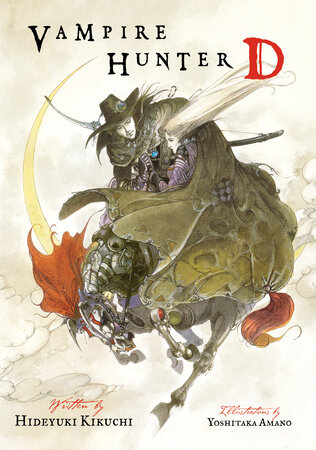
Vampire Hunter D began in January 1983, when Asahi Sonorama published Hideyuki Kikuchi's novel Vampire Hunter "D" with illustrations by Yoshitaka Amano. Kikuchi (born 1949) had broken through only the year before; he has written the series ever since, by hand, and has said he no longer remembers all of its mythology, only that he is careful never to mix up the characteristics of D or lose sight of the purpose of the journey.
The series has sold more than 17 million copies. Its history is a relay: the novels made the films possible, the films made the West pay attention, and the West's attention eventually carried the novels themselves across the Pacific, twenty-two years after they began.
THE PAPERBACK DECADE
1983 to 1992January 1983
Vampire Hunter "D" appears under Sonorama Bunko. D, Doris Lang, Count Magnus Lee, and the talking Left Hand all debut at once.
1984
Amano's art book Maten carries an original D short story, Armageddon: the art and the fiction have been interleaved from the start.
December 1985
The first film, directed by Toyoo Ashida, opens in Japan. Kikuchi dislikes its cheapness and admits, in the same breath, that sales of the novels went through the roof.
1992
Two landmarks: the Dark Nocturne anthology, and the tenth-anniversary hardcover Favorite Printings. In America, Streamline Pictures dubs the 1985 film and bills it as the first animated horror film for adults.
THE SCREEN AND CONSOLE YEARS
1997 to 20011997
Asahi Sonorama publishes Coffin, the first great Amano D art book. In the same year, plans begin at Madhouse for a second film, with Yoshiaki Kawajiri directing.
December 1999
Victor Interactive Software releases the PlayStation game in Japan: survival horror, built on the world of the coming film.
2000 to 2001
Bloodlust premieres at Montreal's Fantasia festival, then opens in Japan in April 2001 and in America that September, in English, the language it was recorded in first.
2001
The Vampire Hunter "D" Reader's Guide collects the world's lore, rare art, and five short stories between two covers.
THE WEST CATCHES UP
2005 to 2015May 2005
DH Press publishes the first novel in English, translated by Kevin Leahy, twenty-two years after the Japanese original.
2007
Asahi Sonorama closes; the series moves to Asahi Shimbun Publishing. In October, Saiko Takaki's manga launches on the same day in Japan and America.
2011
The prequel line begins: Another Vampire Hunter: The Noble Greylancer, drawn not by Amano but by Ayami Kojima of Castlevania.
2015
Sentai Filmworks re-releases the 1985 film with a new English dub, and Discotek Media brings Bloodlust to Blu-ray in America.
THE CURRENT ERA
2021 to 20262021
Dark Horse starts the Omnibus program, three novels per volume, and partners with GraphicAudio on full-cast dramatised audiobooks.
July 2024
Saiko Takaki returns to adapt The Rose Princess as a manga on Asahi's Sonorama+ platform. In English, Gold Fiend closes out Kevin Leahy's Dark Horse contract.
January 2026
The forty-fourth numbered volume, D: Crimson Summer Procession, is the last to carry Amano's interior illustrations. The Complete Illustration Collection gathers them all. Amano keeps the covers.
August 2026
GKIDS acquires Bloodlust for North America, announcing subtitled screenings of the Japanese version and a full theatrical release in 2027.