
The Vampire Hunter D Novel Gallery
One painter has dressed this shelf since 1983, and the first cover is the whole argument.
This is the paper shelf: Hideyuki Kikuchi's Vampire Hunter novels, documented edition by edition, from the first Sonorama Bunko paperback of January 1983 to the newest Japanese volumes. Every main-series cover is a painting by Yoshitaka Amano, who also drew the monochrome illustrations inside each book for more than forty years.
Amano's first cover, pictured here, is the genuine 1983 original: D on his cyborg horse under the Sonorama Bunko band. The rest of the Japanese cover line is documented below in text, volume by volume, with dates and ISBNs, until each cover can be verified as an image. Nothing on this page is pictured that the archive could not check.
THE FIRST COVER
Sonorama Bunko · 31 January 1983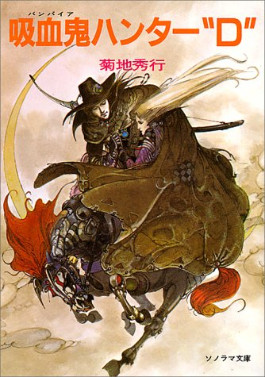
Volume 1 · 1983
The first cover: Amano's D rides out under the original Sonorama Bunko masthead, Kikuchi's name beneath the title. ISBN 4-257-76225-X.
Why this cover matters
Before Final Fantasy, before the films, this painting fixed what D looks like: the wide-brimmed hat, the black cloak, the beautiful, unreadable face. Every adaptation since has been measured against it.
The Bunko format
Sonorama Bunko was Asahi Sonorama's pocket paperback line. The D novels were cheap, portable, and everywhere in 1980s Japan, which is how a horror paperback became a phenomenon.
THE FIRST RUN
Sonorama Bunko, 1983 to 1988Volume 2 · Raiser of Gales
10 May 1984. ISBN 4-257-76274-8. A winter-locked village, a Noble stronghold, and children who came back wrong.
Volume 3 · Demon Deathchase
31 July 1985. ISBN 4-257-76310-8. The Marcus clan races D for a runaway couple. Fifteen years later this book became Bloodlust.
Volume 4 · Tale of the Dead Town
31 January 1986. ISBN 4-257-76321-3. A floating city of five hundred people, cruising a metre off the ground, hires the hunter.
Volume 5 · The Stuff of Dreams
25 December 1986. ISBN 4-257-76361-2. A sleeping beauty bitten thirty years ago, and a whole town dreaming of D before he arrives.
Volume 6 · Pilgrimage of the Sacred and the Profane
5 March 1988. ISBN 4-257-76400-7. Granny Viper hires an escort across a desert that has a mind of its own.
Volume 7 · Mysterious Journey to the North Sea
1988, in two parts. The English edition keeps the split: its volumes 7 and 8 are this one novel.
THE ANTHOLOGY AND THE LONG RUN
1992 to the presentDark Nocturne · the supplemental volume
31 January 1992. ISBN 4-257-76586-0. Three novellas first serialised in Asahi Sonorama's magazine Shishi-oh, shelved outside the main numbering and never renumbered since.
Volume 8 · The Rose Princess
1994. The novel Saiko Takaki returned to adapt as a manga in 2024, thirty years on.
Pale Fallen Angel
1994 to 1996, in four parts: the first of the series' multi-volume novels, and the point where the shelf starts needing a census, not a list.
THE COVER LINE IN THREE LIVES
Bunko · Aizoban · SelectionLife one · Sonorama Bunko, 1983 to 2007
The original paperbacks, Amano covers over the Bunko band. This is the form the series was famous in, and the form first printings hide in.
Life two · the Favorite Printings, 1992 to 1993
For the tenth anniversary, Asahi Sonorama issued the first seven volumes plus Dark Nocturne as hardcovers, each with a new Amano cover and a new colour illustration inside. The deluxe objects of the line.
Life three · Sonorama Selection, 2007 to 2008
Asahi Sonorama closed in September 2007. Asahi Shimbun Publishing reprinted the whole catalogue under the Sonorama Selection label between December 2007 and January 2008, ISBNs in the 4-02-265 block, e-books included.
READING THE COVERS
What the line showsOne hand, four decades
Amano painted every main-series cover from 1983 onward, and drew the interior illustrations until the volume released in January 2026. No other shelf in this Library has a single artist's run that long.
The cover that travels
When an English volume compiles a multi-part novel into one book, Dark Horse presents the second part's Japanese cover inside as a colour frontispiece. The art crosses the Pacific even when the edition changes shape.