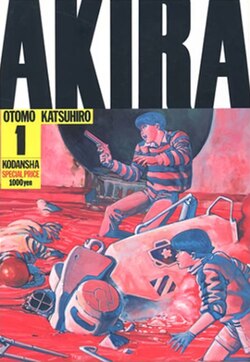
What inspired Akira?
This page prints only what Katsuhiro Otomo has said himself, in interviews and in his own writing. The first influence is the one he has repeated for decades. "I've said this often before," he told his interviewer in the conversation Kodansha published in 2019, "but one of my influences as I made Akira was Tetsujin 28-go. This was a manga series meant for kids, with numbers applied to the cast of characters, and I wanted to make an homage to this series." Mitsuteru Yokoyama's giant robot classic supplied more than a mood: Akira is the 28th of the government's numbered psychics, the espers beside him carry numbers 25, 26 and 27, and the names Kaneda, Tetsuo, Shikishima and Ryusaku all come from Yokoyama's cast. In his Forbes interview Otomo stated the plot debt just as plainly: the grand plot of Akira is about an ultimate weapon developed during wartime and found during a more peaceful era, and "if you know Tetsujin 28-go, then this is the same overall plot."
The setting is autobiography, in his own telling. "I wanted to draw this story set in a Japan similar to how it was after the end of World War II: rebelling governmental factions, a rebuilding world, foreign political influence, an uncertain future, a bored and reckless younger generation racing each other on bikes. Akira is the story of my own teenage years, rewritten to take place in the future." The period detail he lists is the later Showa era he grew up in: preparations for the Olympics, rapid economic growth, and the student unrest of the 1960s, recreated, in his words, to craft an exciting story that would seem believable enough in reality. He has been equally plain about what the work is not: in the same Kodansha interview he said he has no intention of expressing political views or philosophical opinions in it, and that readings of the comic as a political statement distort it.
The line itself has a named source. In the late 1970s, after he had begun drawing comics, Otomo discovered the French artist Moebius, Jean Giraud. His quoted account of the shock survives in comics historian Paul Gravett's profile: "At the time, manga was confined to the real, the everyday, the concrete, the social. Everyone swore only by 'gekiga', the adult version of manga which used lots of frames and sombre compositions. The clear yet very expressive and detailed line of Moebius was a real revelation. A fantastical universe like that of Arzach pushed us out of our routines. I was far from being the only one to be influenced." His own words, not a profile's summary, confirm it from the other end of his life: the obituary Otomo himself wrote for Moebius in the Asahi Shimbun in 2012 recalls Arzach as "wondrous" and "storybook-like" and a shock on first encounter, contrasts Moebius's calm, cool, even lines with the energetic gekiga manner, and closes, as Anime News Network reported it, with Otomo happy to have lived in the same age as Moebius and to have taken so much from him.
The last named influence explains the backgrounds, the part of Akira's art no reader forgets. In the Kodansha interview Otomo said: "I think drawing backgrounds in this much detail was influenced by the manga of Shigeru Mizuki, whom I'm a huge fan of. Reading his work made me realize how important to the story it is to have detailed backdrops in place. The reason is simple: Backgrounds take up the most space in any panel." Attributions that circulate without his statement behind them, however plausible they sound, are not on this page. The record he left himself is specific enough: a robot numbered 28, his own postwar childhood, a French revelation, and Mizuki's backdrops.
THE INFLUENCES, ON HIS OWN SAY-SO
Interviews and his own writing onlyTHE FIRST VOLUME
Akira, 1984