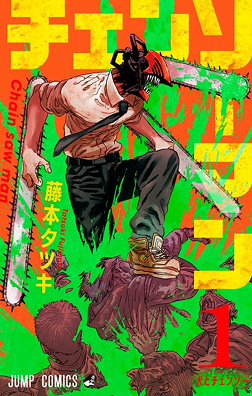
What inspired Chainsaw Man?
This page prints only what Tatsuki Fujimoto has stated on the record about his influences. Where a resemblance is fan inference rather than his statement, it is not here. His headline answer is simple: he was inspired by the 1974 film The Texas Chain Saw Massacre to create the series, a debt he acknowledged as early as his volume 2 author comment: 'I love Texas Chainsaw Massacre!' At MAPPA's tenth anniversary event he explained the appeal in one line: the chainsaw was cool.
The structure he borrowed
Korean films, in his wordsFujimoto has said he wanted to 'draw manga like Korean films', naming the 2008 film The Chaser as the example: the hero catches the villain thirty minutes in, the moment a normal film saves for the end, and the audience is left wondering what could possibly happen next. 'A lot of people say that in Korean movies they cannot tell what the director is thinking, but actually, if you watch until the end, you will get it. I wanted to make something like that.' Chainsaw Man's habit of spending its biggest turns early, then living in the aftermath, is that stated method at work.
His other named film influences include the 2016 Japanese film Sadako vs. Kayako, Koji Shiraishi's Senritsu Kaiki File Kowasugi! series, the 2011 Indonesian film The Raid, and the work of Takeshi Kitano. Among manga authors he has named Hiroaki Samura, Hideki Arai, and Tsutomu Nihei.
His own labels for the series
Copycat, wicked, popFujimoto has described Chainsaw Man, in his own phrases, as a 'copycat of Dorohedoro and Jujutsu Kaisen', a 'wicked FLCL', and a 'pop Abara', the last a nod to Tsutomu Nihei's manga, whose protagonist shares Denji's name. He has also pointed to a specific scene as a direct influence: on social media he cited the final battle of the 2016 film Kizumonogatari Part 3: Reiketsu as a direct influence on the climax of Part 1.
Even his villains have a stated, practical origin. Asked why the series is filled with devils, Fujimoto answered: 'Because if the opponent isn't human, I can draw their internal organs. That's really the only reason.' The Library prints the quote as he gave it: a working artist's reason, not a symbolism.
Part 2 and The Big Lebowski
The aftertaste he wantedAsked by Da Vinci magazine what readers could expect from Part 2, Fujimoto cited the 1998 film The Big Lebowski: it left him questioning the ending and feeling like it was all for nothing, and he loved, in his words, 'this sublime absurdity'. He hoped to give readers that kind of aftertaste, while noting that his protagonist and story had developed. It is a useful key for collectors reading Part 2's quieter, stranger tone against Part 1: the shift was the stated intention, not an accident of the move to Jump+.
THE FIRST VOLUME
Chainsaw Man, in print