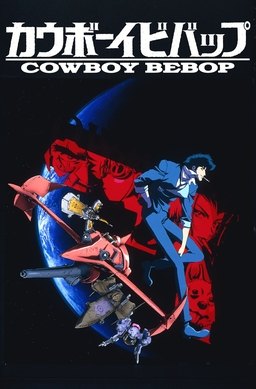
What inspired Cowboy Bebop?
Begin with the commission, because Watanabe always does. Producer Masahiko Minami's account, from the 2018 twentieth-anniversary roundtable: Bandai wanted a breath of fresh air and new plastic models to sell, and asked Sunrise for a show that featured spaceships, into an expected Star Wars boom. Watanabe's version, to Forbes: Bandai thought spaceships would be key, "so they wanted to sell new plastic models of original spaceships... As long as there were spaceships, we could do whatever we wanted." The brief was one line long, and behind it he built the least toyetic show imaginable. Bandai's toy division eventually withdrew, judging the models unsellable; Bandai Visual took over as sponsor, and the show was finished exactly as conceived.
The influences are on the record from Watanabe's own mouth. At Otakon in 2013 he walked through them: he was introduced to jazz by Miles Davis's Kind of Blue and never left; the anime that influenced him most was the original Lupin III television series, a debt he repeated at Japan Expo in 2018 and in his 2019 AMA, where he called the first Lupin series his all-time favorite. And he pointed fans to American movies of the 1970s, not Hollywood in general: the first Dirty Harry, The Wild Bunch, Peckinpah, Don Siegel.
The combination is the show: a Lupin-shaped crew of charming outlaws, drifting between jobs; jazz as the operating system, improvisation as a directing method; and a 1970s American cinema's worth of westerns, noir and kung fu passing through a spaceship that existed to sell toys it never sold. Cowboy Bebop is what happens when a sponsor's one-line brief meets a director with a complete record collection and no intention of wasting the freedom.
THE COMMISSION AND THE INFLUENCES
One brief, three shelves