
From the Library: covers, censuses, and editions, documented. Browse the Library →
SOJ Rurouni Kenshin · The Premise
← Back to the Library

What is Rurouni Kenshin?

A former assassin of the Bakumatsu, wandering Meiji Japan with a sword that cannot kill.

In 1878, eleven years into the Meiji era, a slight, soft-spoken wanderer named Himura Kenshin arrives in Tokyo carrying a sakabatō, a katana forged with its edge on the inner curve so that it cannot easily take a life. A decade earlier he was Hitokiri Battōsai, the most feared assassin of the revolution that created modern Japan. The manga is the story of his atonement: he protects the people in front of him, one dojo at a time, while the men he fought beside, and against, keep arriving to collect old debts.

The title is Watsuki’s own coinage. Rurouni fuses rurō, wandering, with rōnin, the masterless samurai: a word for a man the new era has no slot for. It worked. By 2019 the manga had more than 72 million copies in circulation, and it has been a television anime twice, five live-action films, and a stage of Japanese pop culture that never quite closed.
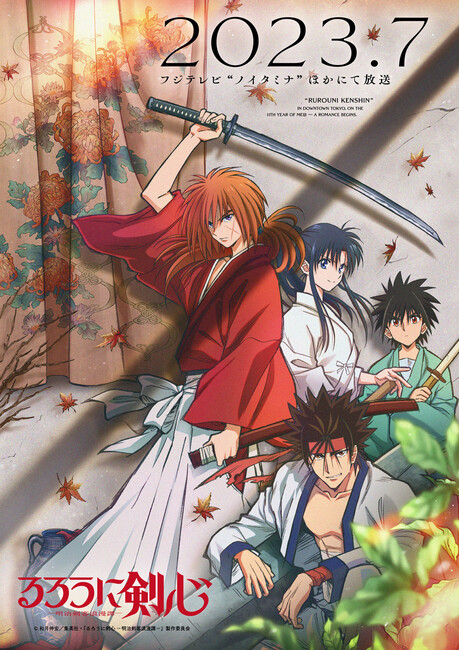
Key visual for the 2023 Rurouni Kenshin anime showing Kenshin, Kaoru, Sanosuke and Yahiko
THE WANDERER, AGAINThe 2023 anime's key visual: Kenshin with Kaoru, Sanosuke and Yahiko. The premise has now been introduced three times over — the 1994 manga, two television anime and five live-action films.

THE SHAPE OF IT

Three arcs, one vow
Tokyo
The opening movement: Kenshin builds a home at the Kamiya dojo while old enemies test whether the Battōsai is really gone.
Kyoto
The centre: Shishio Makoto, the assassin who replaced Kenshin and was burned for it, moves to overthrow the Meiji government, and Kenshin must become strong without becoming a killer again.
Jinchū
The close: Yukishiro Enishi comes for revenge over the death of his sister Tomoe, Kenshin’s wife, and the manga turns to face the assassin years directly.

WHY IT LASTED

The serious shōnen
An adult hero
Watsuki deliberately made his hero a grown man with a past, in a magazine of boy protagonists: the tension is not whether Kenshin can win, but what winning costs him.
History as furniture
The Shinsengumi, the Sekihō Army and real Bakumatsu figures share the page with invented sword schools, and the real dates are kept honest.
More from the Library
MORE FROM THE RUROUNI KENSHIN ARCHIVE →
One shelf in the Library. Browse them all →

THE FIRST WORD

New pages and new pieces, first.