
From the Library: covers, censuses, and editions, documented. Browse the Library →
SOJ The Symbol · Blade of the Immortal
← Back to the Library

What Is the Symbol on Manji's Back?

It is a manji: a Buddhist emblem thousands of years old, and it is also the hero's name.

Readers meeting Blade of the Immortal for the first time often stop at the mark on the back of Manji's kimono. The character is called Manji, written with the single character 卍, and he wears that character as his crest. The symbol's name in Japanese is simply manji, and in Japan it is an everyday sight with an everyday meaning: it is the mark used on Japanese maps to show the site of a Buddhist temple.

The manji belongs to a family of swastika symbols used across Eurasia for millennia, in Buddhism, Hinduism and Jainism, as an emblem of auspiciousness, peace and harmony. In its Buddhist use in Japan it is drawn facing left, as Manji wears it. The emblem adopted by the Nazi party in the twentieth century is a different object with a different history: right-facing and tilted, drawn from the same ancient stock but made into something else. Samura's mark is the temple one, worn by a character named after it, in a story set centuries before the twentieth century existed.
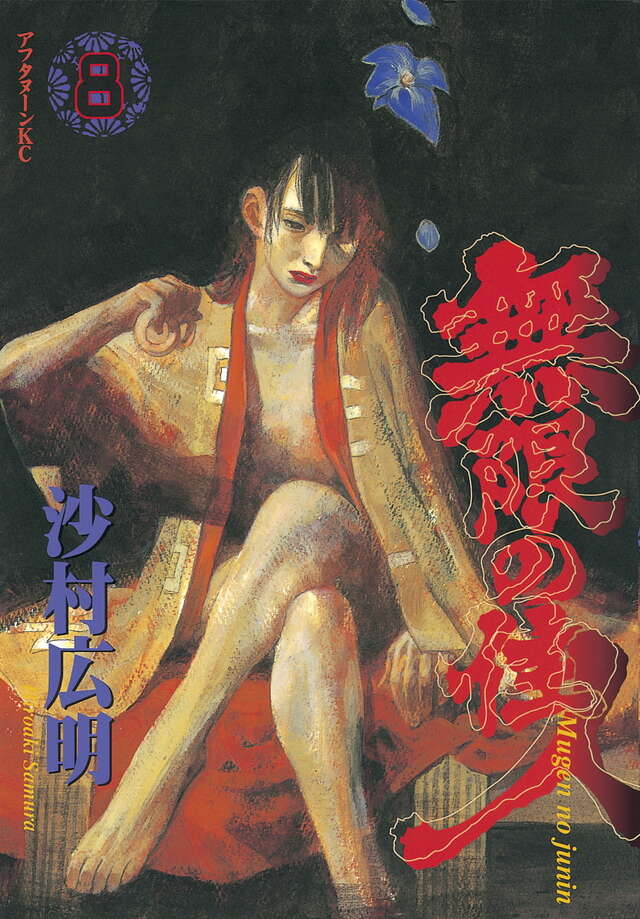
Blade of the Immortal volume 8 Japanese cover, Afternoon KC
VOLUME 8Volume 8 of the Japanese tankobon, Afternoon KC. Samura painted all thirty covers himself, and they were never redesigned.

THE FACTS, IN ORDER

What the symbol is and is not
The name
Manji is not a nickname. It is the Japanese word for the symbol itself, so the hero is named the way a Western story might name a knight for the cross he carries.
The orientation
Direction matters in this family of symbols. The Buddhist manji of Japan faces left; the Nazi Hakenkreuz faces right and stands tilted on a point. They read as different signs to anyone who knows the set.
The everyday use
Far from being hidden, the manji is printed on ordinary Japanese street maps as the standard icon for a temple, as unremarkable in Tokyo as a church cross icon is on a map of London.
The publishing consequence
The symbol shaped publishing history. One reason Samura forbade mirror-flipping the English edition is that a flipped page would reverse his crest into the other orientation: the art had to be rearranged instead, panel by panel. That story is told on the left-to-right page.
More from the Library
MORE FROM THE BLADE OF THE IMMORTAL ARCHIVE →
One shelf of the Library. Browse them all →

THE FIRST WORD

New pages and new pieces, first.