
From the Library: covers, censuses, and editions, documented. Browse the Library →
SOJ The Swordsman ยท Blade of the Immortal
← Back to the Library

Who Is Manji?

A swordsman who cannot die, working off a debt of a thousand lives.

Manji was a samurai in the service of the hatamoto Horii Shigenobu. When he discovered his lord's corruption he killed him, and became an outlaw with a name earned in the fighting that followed: the Killer of 100. Among the hundred were men he had no quarrel with, including his own brother-in-law, and the death of his sister Machi, the one person he had left, finished what was left of him.

Then the 800-year-old nun Yaobikuni gave him the kessen-chu, the sacred bloodworms, and dying stopped being available. Manji's bargain with her frames the whole series: to earn his mortality back he must kill 1,000 evil men, one for every ten he wronged. It is why an immortal with no reason to care hires himself out as a bodyguard to a teenage girl: Rin Asano reminds him of Machi, and her war is the first work that fits the debt.
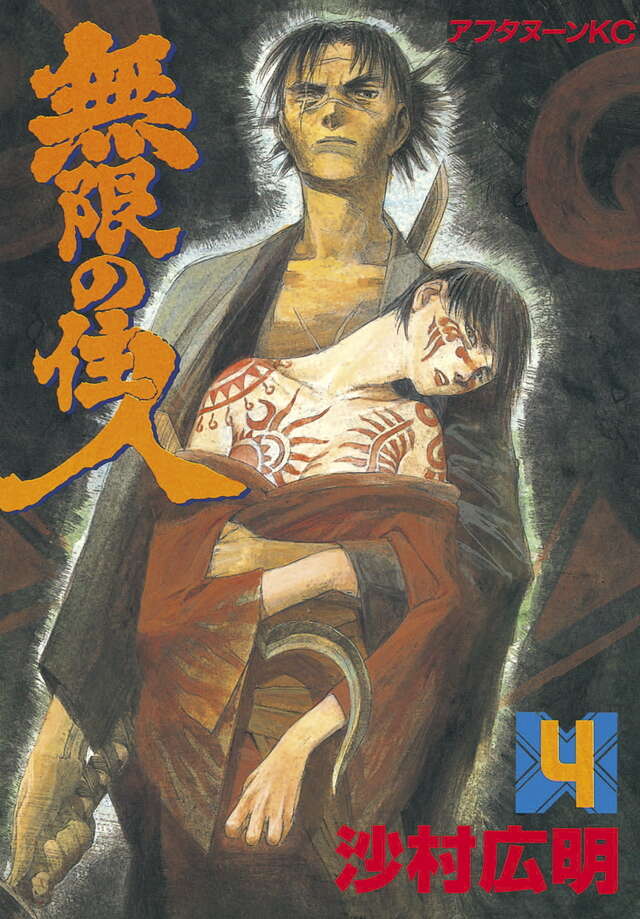
Blade of the Immortal volume 4 Japanese cover, Afternoon KC
VOLUME 4Volume 4 of the Japanese tankobon, Afternoon KC. Samura painted all thirty covers himself, and they were never redesigned.

THE BLOODWORMS

What the kessen-chu do, and what they cannot
The healing
The kessen-chu live in Manji's blood and close his wounds as they happen, knitting tissue and reattaching what has been severed. In story terms they are the reason a fight with Manji is a contest of endurance rather than skill.
The limits
The worms repair; they do not create. Large-scale tissue loss is beyond them, which keeps even an immortal body something that has to be defended, and gives the series its rule that no victory is free.
The paradox
Manji's immortality is written as a craftsman's problem: a swordsman who cannot be killed stops sharpening himself. His discipline has decayed across his long life, and the series treats that decay, not the healing, as the curse.
The other immortal
Manji is not the only carrier. Eiku Shizuma received the bloodworms in the Muromachi period and is over two hundred years old; he also carries kessen-satsu, a toxin brewed to kill the worms themselves.

THE ARSENAL

A walking armoury
The paired swords
Manji's named blades include the paired swords Shido and Imo-no-Kami Tatsumasa, carried among a much larger hidden arsenal.
The chained sickles
Mumei, his chained sickles, extend his reach and let him fight at distances a katana cannot cover.
The sword-breaker
The Kotengu is a sword-breaker, a tool for catching and snapping an opponent's blade: a craftsman's answer to better swordsmen.
The principle
A dozen concealed weapons is the character in one detail. Manji does not fight as a purist of one school; he fights as a survivor, which puts him closer to the Itto-ryu heresy than to the dojo world he protects Rin from.
More from the Library
MORE FROM THE BLADE OF THE IMMORTAL ARCHIVE →
One shelf of the Library. Browse them all →

THE FIRST WORD

New pages and new pieces, first.