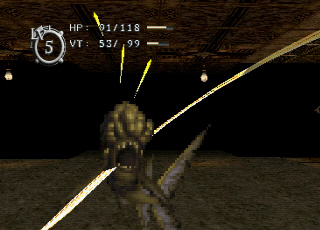
Why Does Dying Advance the Story in Baroque?
In most games of its era, death was a tax: lose progress, reload, repeat. In Baroque, death is the mechanism of the narrative itself. When the protagonist dies in the Neuro Tower, he does not get a game over screen. He wakes in the town outside, stripped of items, experience, and levels, and the world has quietly moved: townspeople say new things, scenes that were locked become available, memories surface, and the tower itself can gain floors it did not have before.
The fiction justifies the system completely. Each descent is an attempt; each death returns the boy's gathered experience to the Consciousness Orbs, the divine sense organs the story revolves around. What the player learns and what the protagonist learns are the same thing, and the game counts both. Even your equipment participates: throw up to five items into a Consciousness Orb before a run ends and a character in town can hand them back on the next life.
The result is a loop that punishes and teaches in the same motion. The tower is hard, hunger is constant, and almost nothing is explained, but no run is wasted, because the story only fully exists across many deaths. Structures that later roguelikes would make famous, progress through repetition, lore through failure, were here, on the Sega Saturn, in 1998.