
How can you tell a real 1997 Weekly Shonen Jump No.34 from a reprint?
In 2017, Shueisha itself reprinted the One Piece debut issue as a facsimile, and a facsimile is built to match: the cover, the printed price, the date line and chapter 1 all reproduce the 1997 original. Nothing on the front separates the two printings. What separates them is a handful of editorial changes Shueisha had to make inside the reprint, plus the way the reprint was sold. Learn those, and a copy gives itself away.
First, the two objects. The original is Weekly Shonen Jump 1997 No.34, cover dated August 4, 1997, on sale July 22, 1997, with a printed special price of 210 yen, carrying Eiichiro Oda's One Piece chapter 1, "ROMANCE DAWN," as the lead colour feature. The reprint is the "Fukkokuban Weekly Shonen Jump" Pack 2, released August 12, 2017 for the magazine's 50th anniversary: the 1997 No.34 bundled with the 1987 New Year No.1-2, the JoJo's Bizarre Adventure debut issue, the two magazines together priced at 833 yen plus tax.
THE ISSUE ITSELF
Identity, which both printings share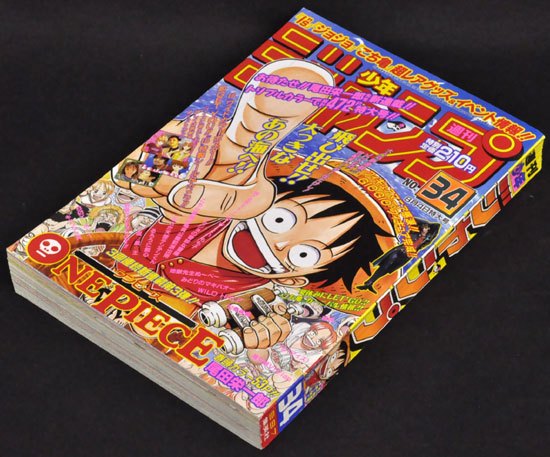
The contents confirm the issue, not the printing. Both versions run the same lineup, documented in the Agency for Cultural Affairs' Media Arts Database: One Piece first, then Rurouni Kenshin, JoJo's Bizarre Adventure in centre colour, Hoshin Engi, I"s, KochiKame, Yu-Gi-Oh! and Captain Tsubasa: World Youth, among others. Chapter 1 runs as the lead colour feature of the issue. If a copy's lineup differs, it is not this issue at all. If it matches, you have identified the issue, and the printing question is still open.
WHERE THE REPRINT GIVES ITSELF AWAY
The verified tells1. It was never sold alone. Shueisha sold the reprint only inside Pack 2, shrink wrapped with the 1987 JoJo debut issue, as one 833 yen product in a three month anniversary series. A copy that still sits in its pack, or arrives with its JoJo partner, is the reprint by definition. Loose single copies in today's listings were separated from a pack, which is exactly why the interior checks below matter.
2. The survey postcard is blacked out. The reprint reproduces the reader questionnaire postcard, but with the postal code, the mailing address and the department name blacked out, because a 1997 survey cannot be mailed in 2017. On an original, that postcard is printed clean and fully legible. Find the postcard page: black bars mean reprint, settled.
3. The prize pages carry an ending notice. Where the original prints live 1997 reader prizes with their entry addresses and contact details, the reprint replaces those details with a printed notice that the promotion has already ended and is no longer running. An original has no such notice anywhere in it.
4. Some ad pages are withheld, and say so. Most period advertisements are reproduced as they ran, but the ones Shueisha could not reprint are replaced by a page carrying the notice "この広告は事情により掲載を見送りました," which reads "this advertisement was withheld from publication for various reasons." An original carries a real 1997 advertisement on every advertising page. One withheld ad page settles the copy in front of you.
5. Paper and age support, but never settle. A 1997 Jump is cheap newsprint that has had nearly three decades to yellow, soften and pick up the smell of storage. A bright, white, crisp copy claiming to be the original deserves suspicion, and a tired, toned copy supports an original reading. Treat this as a pointer toward the interior checks, never as the verdict: storage decides condition, and the notices above decide the printing.
THE HONEST LIMIT
What photographs cannot doThe decisive pages on this checklist are interior editorial pages, and most marketplace listings never photograph them: covers and the chapter 1 colour spread are what sellers show, and both are identical between printings. So this page cannot certify an individual copy from a standard listing, and neither can anyone else. Before paying original money for a loose copy, ask the seller for photographs of the survey postcard page and of the advertising pages. A seller holding a genuine 1997 printing can produce them in a minute, and the answers are printed on the pages themselves.
One more version exists, and it is not a print rival: in June 2015, Shueisha posted the entire 1997 No.34 issue free on its Shonen Jump+ app, to mark One Piece's Guinness World Record. That is a digital posting of the issue, not a third printing, and it explains why perfect images of the issue circulate online. Perfect images are not a printing.