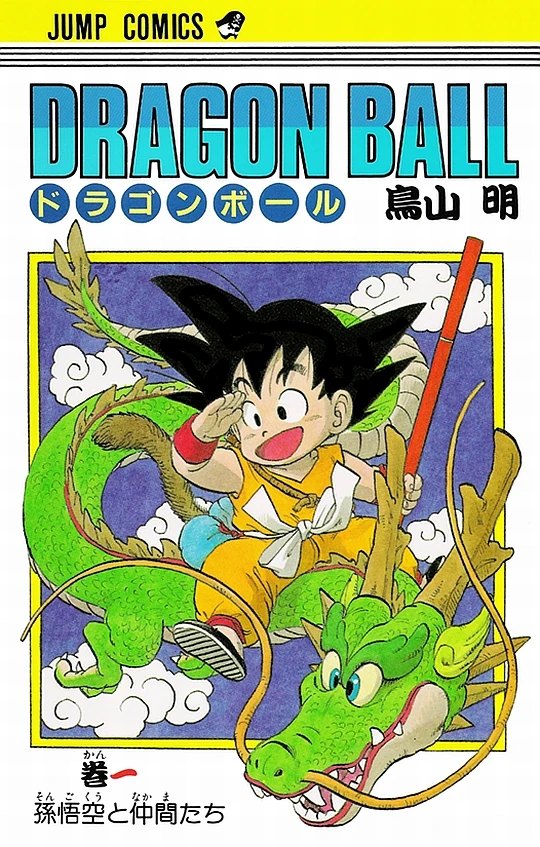
How did Dragon Ball run in Weekly Shonen Jump?
Dragon Ball began in Weekly Shonen Jump issue 1984 No.51, on sale November 20, 1984 (the issue is dated December 3), priced at 170 yen, with Goku on the cover of his own debut. The handoff was brutally fast even by Jump standards: Akira Toriyama's previous hit, Dr. Slump, had ended in issue No.39 of the same year, and three months later he was back at the top of the magazine. The bridge between them was editor Kazuhiko Torishima's advice and a test run: the two part one-shot Dragon Boy, published in Fresh Jump in 1983, tried out the kung fu adventure formula, drew an enthusiastic reader response, and became the template. Toriyama has said he initially intended the series to end once the seven Dragon Balls were first collected. The reader surveys had other plans.
Weekly Shonen Jump ran on those surveys like a stock exchange. Readers ranked the chapters, the rankings decided placement and survival, and editor in chief Nobuhiko Horie has described the discipline plainly: a series whose results stayed poor could face cancellation pressure within three weeks, against a customary grace of about ten. Dragon Ball passed the test so completely that it inverted it. The magazine's circulation climbed with the series: an annual average of 3.9 million in 1984, 4.35 million by the start of 1986, 4.85 million by the end of 1987, and a peak of 6.53 million copies for the 1995 New Year issue, the largest circulation in the magazine's history, achieved in Dragon Ball's final year. The anime followed the manga's gravity, debuting February 26, 1986, and itself feeding back into the manga's art and Goku's voice.
The run ended in 1995, after 519 chapters and 42 collected volumes, with Toriyama exhausted and the magazine at its summit. What happened next is the cleanest evidence of what the series had been carrying: with Dragon Ball and its fellow pillar Slam Dunk both gone, Jump's circulation slid to about 4.15 million by 1998. The cover census tells the same story in pictures: in the years documented on the record so far, Dragon Ball was the featured cover illustration once in 1984, five times in 1985, five in 1986, five in 1987, and three in 1988, the magazine putting its engine on the front at a rate no modern series sustains. It was not a long running series in a big magazine. It was, for a decade, the reason the magazine was big.
THE RUN, BY THE NUMBERS
1984 to 1995THE BOOK ON THE SHELF
Dragon Ball · Vol. 1