How Did Dragon Quest VIII Break Through in the West?
For twenty years Dragon Quest was the biggest series in Japan and a footnote in the West: renamed Dragon Warrior, sparsely released, and never released at all in Europe's PAL region as a main series game. Dragon Quest VIII (2004 in Japan, 2005 in North America, 2006 in PAL) changed the pattern in one generation. The question is what, exactly, did the changing: the answer is a stack of documented decisions, not a single lucky break.
THE VERDICT
The short answerDragon Quest VIII broke through because Square Enix removed every obstacle that had kept the series out: the name was restored, the translation was treated as a headline feature, voices and an orchestra were added for the West, a Final Fantasy XII demo put the game in front of the rival series' entire audience, and Europe was given a main series entry for the first time. The result: over 430,000 copies in North America alone, within worldwide shipments past 4.9 million, and the standing, years later, as the most popular entry in the West.
THE NAME
Dragon Quest, at lastThe series had been Dragon Warrior in North America since 1989 because of a trademark conflict with a pen and paper role playing game called DragonQuest. In 2003, Square Enix registered the Dragon Quest trademark in the United States, retiring the conflict. Dragon Quest VIII was the first game released outside Japan after that registration, and so the first to carry its real name in the West: the same name Japanese players had always used, and the name the series' growing internet coverage used.
THE LOCALIZATION
The translation as the featureUnlike earlier entries, the game was not censored in North America. The English script, led by Richard Honeywood with translation by Plus Alpha and AltJapan, gave the game a deliberately British tinted voice: regional accents, comedy played straight, a Cockney Yangus. A majority of Western reviewers then named the localization one of the game's best qualities; 1UP praised the humor, and Eurogamer called the voice acting a mash up of Monty Python and The Princess Bride and the ideal vehicle for the story. No earlier Dragon Quest had been reviewed as a writing showcase in the West, because no earlier one had been localized like one.
THE ADDITIONS
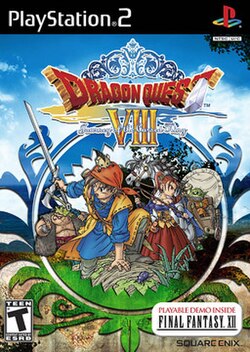
Voices, an orchestra, and a demo discThe Japanese original has no voice acting and uses sequenced music. The Western versions added voice acting for story scenes, redrawn menus, new animations and effects, and the symphonic suite recordings performed by the Tokyo Metropolitan Symphony Orchestra under Sugiyama himself. Then came the distribution masterstroke: the North American box contained a playable demo of Final Fantasy XII, putting Dragon Quest in the hands of the one audience guaranteed to buy a big Japanese RPG that season. The badge is printed on the American box in this Library's gallery.
THE EUROPE DOOR
A first release, explained by the mergerPAL regions had never received a main series Dragon Quest. VIII arrived in April 2006, as Dragon Quest: The Journey of the Cursed King. Horii explained the door opening with the 2003 merger of Square and Enix, which let the combined company release more games in more places, and producer Ryutaro Ichimura added that European tastes had shifted with the influence of anime. In Japan's terms the breakthrough at home was already total: the fastest selling PlayStation 2 game in Japanese history, and its biggest seller ever. The West was the frontier, and for once the company marched on it with its full weight.
THE GAME ON THE SHELF
Dragon Quest VIII · PS2