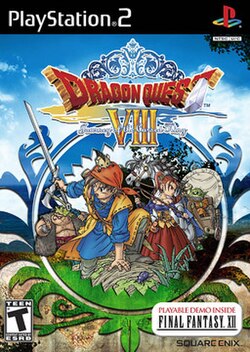
The History of Dragon Quest VIII
Dragon Quest VIII: Journey of the Cursed King (PlayStation 2, 2004) did the most conservative thing in the series' history and somehow made it radical: it kept the menus, the turn order, and the fairy tale shape exactly as they were, and rebuilt the world around them as a fully three dimensional place you could walk across. It became the biggest selling PlayStation 2 game in Japan, and, after two decades of near misses, the Dragon Quest that finally landed in the West. That breakthrough has its own page in this Library.
THE MAKING
Level-5 takes the crown jewelsThe series' core trio stayed in place: Yuji Horii as scenario designer and director of the whole, Akira Toriyama designing characters and monsters, Koichi Sugiyama composing. The development itself went somewhere new: to Level-5, whose Dark Cloud games had impressed Enix. Level-5 president Akihiro Hino, who also directed, initially declined the offer, occupied with Dark Cloud 2 and unsure the project was within him, before accepting the largest job in Japanese games.
Preliminary development began in 2001. The launch itself was an event: the game went on sale in Japan at 6:30 in the morning on November 27, 2004, with a celebration at a Starbucks in Shibuya, Horii and Square Enix president Yoichi Wada in attendance, and early buyers handed a toy Slime.
THE DESIGN
Cel shading, tension, and a world at full scaleDragon Quest VIII is the first game in the series with fully 3D environments and character models, drawn with cel shading so that Toriyama's art survives the move intact: the Hero, the bandit Yangus, the sorceress Jessica, and the templar Angelo look like drawings that learned to walk. Towns and dungeons are no longer icons on a map; they are full sized places on one continuous landscape, with a camera the player can swing a full circle.
Under the new paint, the structure is pure tradition, with exactly two additions that matter. The tension system lets a character spend turns psyching up to multiply the next attack, turning patience into a resource. The Alchemy Pot mixes items into stronger ones as you travel. Skill points, earned per level and spent across five tracks per character, quietly add the series' first real character building.
THE EDITIONS
Two different games by regionTHE RECEPTION
Records at home, a breakthrough abroadTHE LEGACY
The face of the series in the WestWhen Super Smash Bros. Ultimate needed one Dragon Quest hero to stand for the series, it chose this game's protagonist, and the game's director at Nintendo said why on the record: Dragon Quest VIII was the most popular entry in the West at that point. The cursed king's guard became the series' Western face.
The party kept working, too: Jessica, Yangus, and Angelo returned in the Dragon Quest Heroes games, Trode and his daughter appear as guests in Dragon Quest IX, and the Hero's outfit was given to Dragon Quest XI players as a bonus. For SOJ's shelf, this is the hinge title of the whole era: the one where the Japanese institution and the Western audience finally met.
THE GAME ON THE SHELF
Dragon Quest VIII · PS2