
From the Library: covers, censuses, and editions, documented. Browse the Library →
SOJ Akira · The Craft
← Back to the Library

How did Katsuhiro Otomo draw Neo-Tokyo?

Neo-Tokyo was drawn like a place that had to stand up.

Start with the workload, because the city’s density is a labor fact before it is a style. In a Kodansha-published interview, Otomo recalled that by the time the film production began, the manga was running on a weekly rhythm: twenty pages a week. He had brought on a second assistant, occasionally enlisting a third just to handle the screentone, and near deadlines the studio pulled all-nighters, after which he would walk straight into the anime studio the next day. He also noted the unusual shape of his career: he did helper work young, but never served as an assistant in another artist’s studio. The hand that drew Neo-Tokyo was self-trained.

The city itself was built the way its author builds everything: from a real skeleton outwards. Neo-Tokyo grows around the actual geography of its predecessor, the 1964 Olympic stadium site becoming the new city’s Olympic ground, craters, expressways and military architecture laid over a Tokyo Otomo knew street by street.
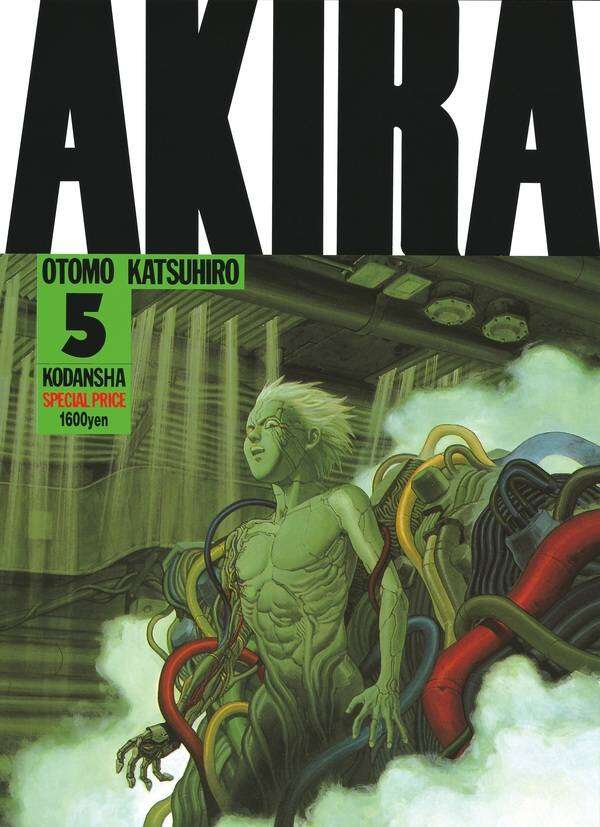
Akira volume 5 English cover (Kodansha Comics)
NEO-TOKYO IN RUINSVolume 5 of the Kodansha Comics edition: the story's long middle act plays out across the wrecked city Otomo drew street by street.

THE HAND AND THE STUDIO

How the pages got made
Destruction, cross-hatched by hand
Accounts of the work return to one image: Otomo rendering the destruction of Neo-Tokyo in manual cross-hatching, panel by panel, and refusing editorial suggestions to simplify the pages. A city of millions does not fall in shorthand; the hatching is the weight of it.
Speed as a design rule
Otomo has described composing for momentum: readers should rush through the action and be stopped short at the key images. The famous stillness of the big spreads, the bike, the throne, the blast, is placed the way a filmmaker places a held frame.

THE MACHINES

Designed like products, because they were
Kaneda’s bike
In his 2017 Forbes interview, Otomo gave the bike’s origin precisely: the initial inspiration was the lightcycles from Tron, designed by Syd Mead. “They are wide, so I halved them and used that as an initial basis.” The most famous motorcycle in comics began as an act of editing.
His own mecha, mostly
Otomo is quick to credit collaborators on the film, Koji Morimoto and Kiyomi Tanaka on vehicles, Takashi Watabe on the cryogenic pod’s inner workings. But of the manga he is equally clear: the mech design in the original was his. Neo-Tokyo’s hardware is one man’s industrial design, drawn at a desk.
Akira Club and Kaba → What inspired Akira → More from the Library →
MORE FROM THE AKIRA ARCHIVE →
One shelf of eighty-two in the Library. Browse them all →

THE FIRST WORD

New pages and new pieces, first.