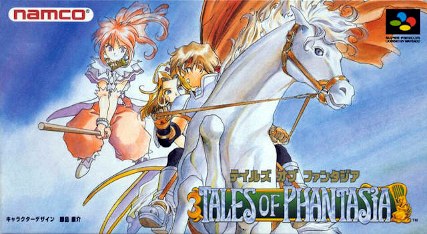
How did Tales of Phantasia fit a sung theme song on a cartridge?
Start with the fact that makes the question worth asking: Tales of Phantasia (Super Famicom, December 15, 1995) is the first, and remains the only, Super Famicom game with an original vocalized theme song. Cartridges of the era held a few dozen megabits of everything: graphics, maps, code, and sampled sound, the most expensive bytes of all. A sung song, plus voiced battle cries and voiced story scenes, should not have fit. Contemporaries did not try.
Wolf Team's answers were hardware and compression. The game shipped on a high-capacity 48-megabit cartridge, among the largest the system ever carried, and the team built a sound system they named the Flexible Voice Drive specifically to record and play back full dialogue and the theme song inside that space. The song itself, Yume wa Owaranai (The Dream Will Not End), was performed by Yukari Yoshida for the Super Famicom original, and it plays over the opening before the title screen gives way to the game: a record single's worth of singing, streamed off a game cartridge in 1995.
The proof of how hard the trick was is what happened later. The PlayStation remake of 1998, on roomy compact discs, kept and re-recorded the voices as a matter of course. But when the game finally reached English on Game Boy Advance in 2006, the sung theme was replaced with an original instrumental track, with licensing issues given as the reason: eleven years on, the song was still easier to substitute than to carry across. The fan translators of DeJap, who released a complete English patch for the Super Famicom version in 2001, had kept it. For the full development story, including the Enix rejection and the staff walkout that founded tri-Ace, see this Library's history of the game.
THE GAME ON THE SHELF
Tales of Phantasia · Super Famicom