The History of Tales of Phantasia
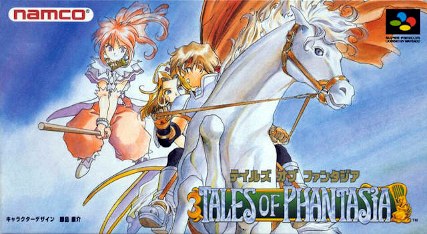
Tales of Phantasia (Super Famicom, December 15, 1995), developed by Wolf Team and published by Namco, opened the Tales series with an idea no cartridge game had tried: it begins with a fully sung theme song. It was released only in Japan on the Super Famicom, at the very end of the system's life, into the same week as Dragon Quest VI. Its first official English release came eleven years later, on Game Boy Advance.
THE MAKING
A novel, a rejected pitch, and a walkoutThe game began as an unpublished Japanese novel, Tale Phantasia, by Yoshiharu Gotanda, who became the game's writer and total programmer. Masaki Norimoto designed it, manga artist Kōsuke Fujishima drew the characters, and Motoi Sakuraba led the music with Shinji Tamura and Ryota Furuya. The world was built primarily on Norse mythology, with names borrowed from Michael Moorcock and H. P. Lovecraft for Western fantasy flavor.
The road to a publisher ran through the competition: after poor experiences with parent company Telenet Japan, Wolf Team pitched the project to Enix first, were turned down, and signed with Namco. Many changes were imposed on Gotanda's story along the way, down to the title. Late in development, internal conflicts drove a large part of the staff out of Wolf Team entirely. They founded a new studio, tri-Ace, a name this Library's Valkyrie Profile pages meet again.
THE DESIGN
Fighting game battles, and a voicePhantasia's battle system, the Linear Motion Battle System, was inspired by the fighting games then dominating arcades: combat plays out in real time on a scrolling two-dimensional line, the player directly controlling Cress while the party fights under player-set tactics. It became the series' defining system for decades.
The audio was the headline. Battle cries and story scenes are voiced, and the game opens with an original sung theme, Yume wa Owaranai, performed by Yukari Yoshida: the first, and still the only, original vocalized theme song in a Super Famicom game. Fitting voices and song onto a cartridge required a 48-megabit cartridge and a custom sound system the team called the Flexible Voice Drive. The full technical story has its own page in this Library.
THE EDITIONS
Japan only, until a handheld rescued itTHE RECEPTION
Japan argued; its readers then crowned itTHE LEGACY
A series, and a studio, start herePhantasia founded one of the long-running RPG series: dozens of Tales games followed, all carrying its battle system, its skits, its sung openings, now standard practice the 1995 cartridge pioneered. The staff exodus gave the industry tri-Ace, and with it Star Ocean and Valkyrie Profile.
Its own reputation inverted its sales. The version that sold least, the Super Famicom original, is the one history kept: the only singing cartridge of its generation, unreleased in the West, and the root of two family trees at once.
THE GAME ON THE SHELF
Tales of Phantasia · Super Famicom