
From the Library: covers, censuses, and editions, documented. Browse the Library →
SOJ Fist of the North Star · The Art
← Back to the Library

How does Tetsuo Hara draw Hokuto no Ken?

Like every chapter was the last thing he would do before he died. His words, and the schedule backs him up.

During the run, Hara produced twenty pages a week of some of the densest art in Weekly Shōnen Jump, plus the painted covers for the tankōbon. He has described being so burned out that he went three or four days without bathing, and an editor, Nobuhiko Horie, who never praised him and simply handed over the next chapter’s script the moment the previous one was finished. Hara later concluded the severity was what he needed. His own summary of the standard he set himself: he worked on every chapter like it was the last thing he would do before he died.

The faces come from the cinema he grew up on: as a teenager he drew Bruce Lee and actor Yūsaku Matsuda from memory, and Kenshiro was built to combine them. Editor Horie steered him to illustrators Syd Mead and Frank Frazetta and to films, Mad Max 2, Blade Runner, Otomo’s Akira, which settled the wasteland’s look. The villains’ famous death cries, Hidebu, Abeshi, Tawaba, were Hara’s invention, deliberate nonsense in the tradition of Fujio Akatsuka’s comedy manga, added, he said, to put a little comedy into the death scenes so readers could digest them. The copy-editors kept “correcting” them; he kept putting them back.

What is less known: Hara has lived with keratoconus, a progressive eye disease, almost since his professional debut. He drew the most eye-straining art in the magazine while his own sight thinned. Surgery in June 2023 improved his visual acuity roughly tenfold, and for the fortieth anniversary he locked himself in his studio and produced dozens of new exhibition pieces.
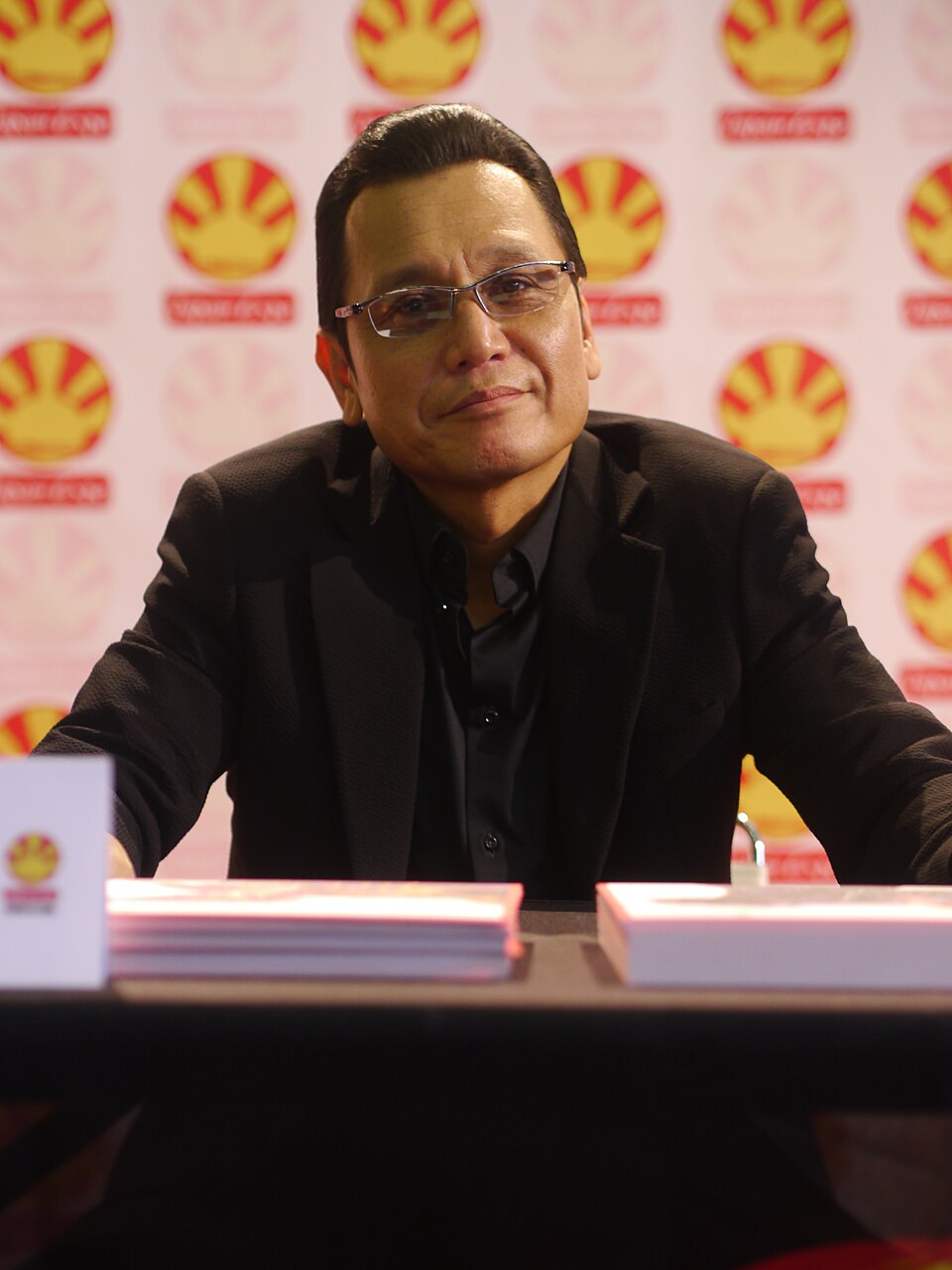
Manga artist Tetsuo Hara photographed at Japan Expo 2013
TETSUO HARATetsuo Hara at Japan Expo 2013 — the hand behind Hokuto no Ken's hyper-detailed ink work and its seven-scarred hero.

THE METHOD, PART BY PART

From Hara’s own accounts
Faces from memory
Lee and Matsuda, drawn obsessively as a teenager, became the template bank for Kenshiro and the men around him: real screen faces, heightened.
Painted covers
The tankōbon covers are full paintings, modelled and lit like film posters, at a time when a Jump cover was usually flat color. He returned to paint eighteen more for the Kyūkyokuban in 2013, and new ones for the English Master Edition before that.
Comedy inside the carnage
The death cries are jokes on purpose. Hara, who had complete freedom over the action scenes, used absurdity as a pressure valve in scenes of extreme violence.
The editor as Raoh
Hara’s own joke at the Jump 50th anniversary talk: Horie was usually nice, but when Hara worked slowly his aura became like Raoh’s, and he would bang the desk. Fear, both men agreed, was a production tool.

AFTER THE RUN

The hand did not stop
Keiji and Fist of the Blue Sky
Hara drew the historical epic Keiji, then returned to the Hokuto world with the prequel Fist of the Blue Sky (2001 to 2010), Kenshiro’s story moved to 1935 Shanghai.
The 40th anniversary
For the 2023 exhibition in Roppongi, and after eye surgery that gave him back his acuity, Hara produced dozens of new works. His verdict on AI art, given the same year, was that it cannot do the one thing his method requires: be resolved to die over the page.
More from the Library
MORE FROM THE FIST OF THE NORTH STAR ARCHIVE →
One shelf of the Library. Browse them all →

THE FIRST WORD

New pages and new pieces, first.