
From the Library: covers, censuses, and editions, documented. Browse the Library →
SOJ The Versions ยท Baroque
← Back to the Library

How Does the Baroque Remake Differ from the Original?

Everything you see and hear changed. Everything you do barely did.

The remake, released for PlayStation 2 in Japan on 28 June 2007 and built on the PlayStation port, is best understood as a translation of the 1998 game into a new sensory language. The camera leaves the protagonist's eyes for a third-person view with full analogue movement and more action-driven combat. The graphics are entirely 3D where the original mixed 3D rooms with 2D sprite people. Full voice acting arrives. Difficulty levels arrive too, a concession the Saturn original would never have made.

The art and sound were not updated so much as replaced. Character designs were redone by Kenjiro Suzuki, succeeding Hyoju Mu's originals, and the new opening animation was produced by Point Pictures. The score is entirely new music by Shigeki Hayashi, Sting's in-house composer from Yggdra Union, where Masaharu Iwata's ambient anti-music had defined the original. Producer Takeshi Santo and lead programmer Shinichi Abe returned from the 1998 team to supervise the handover.

The Wii version, Japan 13 March 2008, adds motion controls and widescreen, and quietly restores an optional first-person camera, the remake's one bow to the Saturn. Atlus USA released both versions in North America on 8 April 2008 with a full English dub, deliberately marketing the game as "hardcore", and Japan later re-imported the Western edition as Baroque International.
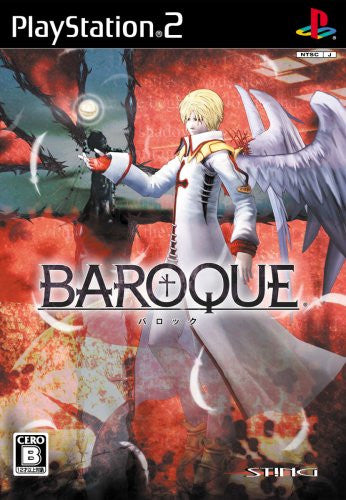
Baroque Japanese PlayStation 2 remake box
THE REMAKEThe Japanese PlayStation 2 box for the 2007 remake, which rebuilt the Saturn game in third person.

SIDE BY SIDE

Original against remake
Camera
Original: first person, tank controls. Remake: third person, analogue, action combat. Wii owners could switch back to first person.
Faces
Original: designs by Hyoju Mu, people as 2D sprites. Remake: designs redrawn by Kenjiro Suzuki, everyone in 3D, everyone voiced.
Music
Original: Masaharu Iwata, ambient noise and samples, music designed not to sound like music. Remake: a wholly new score by Shigeki Hayashi.
Mercy
Original: one difficulty, and it is Baroque. Remake: selectable difficulty levels, the single biggest philosophical change.

THE RECEPTION GAP

What the scores said
60 and 50
Metacritic recorded 60 of 100 for the PS2 remake and 50 for the Wii version. Critics praised the concept and story and punished the difficulty and opacity, the same qualities the cult prizes.
78 percent
RPGFan, the genre's own press, scored it 78 and warned it was only for those who truly appreciate roguelike RPGs. The remake's audience problem in one sentence.
The PlayStation port, comparedWho Made Baroque?
MORE FROM THE BAROQUE ARCHIVE →
One shelf of the Library. Browse them all →

THE FIRST WORD

New pages and new pieces, first.