
From the Library: covers, censuses, and editions, documented. Browse the Library →
SOJ The Makers ยท Baroque
← Back to the Library

Who Made Baroque?

A Compile veteran, a character designer named Hyoju Mu, a CGI artist thinking about wombs, and an American studio on the other side of the Pacific.

Kazunari Yonemitsu conceived Baroque, directed it, co-designed it, and wrote its text. He was a Sting founder who had come from Compile, where he wrote Madou Monogatari and managed the first Puyo Puyo; Baroque was the dark work he had been prevented from making for years. He built it from tarot, from the psychiatry of Bin Kimura, whose books Time and Self and Abnormal Structures the Baroque Report materials name as influences, and from European film.

The characters were designed by Hyoju Mu. The game's 3D and CGI were led by Eisaku Kito, who also designed the enemies: the Grotesques. Production reality shaped the art in a famous way. The models were so elaborate that only about twenty enemies were affordable, marketing feared the small roster would hurt sales, and Yonemitsu argued his way out by declaring the Grotesques were modeled on the 22 cards of the tarot's Major Arcana, a justification invented on the spot that then became real design doctrine. Kito gave the tower's interior a recurring "uterus" aesthetic, its monsters designed as microorganisms infecting a womb.

The CGI itself was produced with Inertia Pictures, an American studio Yonemitsu hired for a look no Japanese house had, across time zones and languages. For the remake a decade later, the faces were redrawn by Kenjiro Suzuki. Any account that credits Baroque's faces to another game's artist is confusing it with a different Sting-adjacent production: the 1998 designs are Mu's, the models and films Kito's.
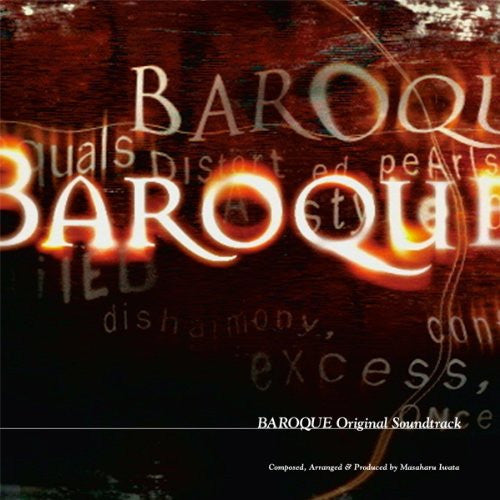
Baroque original soundtrack album cover
THE MAKERS' CIRCLEThe original soundtrack album. Baroque was made by a small Sting team: Kazunari Yonemitsu directing, Hyoju Mu designing, Masaharu Iwata composing.

THE MUSIC PROBLEM

Masaharu Iwata, told to stop writing music
The brief
Yonemitsu asked Iwata, fresh from Treasure Hunter G, for tracks that did not sound like music: the natural soundbeds of documentaries were the reference, and sometimes the direction arrived as a short poem.
The method
Iwata folded sound effects into the compositions themselves. The track Confusion is built entirely from samples. His strangest piece, Namu Ami, is a meaningless Buddhist-style chant of his own invention.
The afterlife
The DigiCube soundtrack album of 21 May 1998 became a rarity; Iwata reissued it through Basiscape on 14 May 2012 with two early demos and two new tracks, one sung to lyrics by Yonemitsu.

THE CREDITS THAT MATTER

For the collector's notebook
Director, story, text
Kazunari Yonemitsu, with Kengo Morita on text and Haruhiko Matsuzaki co-designing.
Producer
Takeshi Santo, who returned for the remake alongside lead programmer Shinichi Abe.
Remake faces and score
Kenjiro Suzuki (designs) and Shigeki Hayashi (music), 2007. Two Baroques, two art teams, one tower.
The History of BaroqueThe Baroque books
MORE FROM THE BAROQUE ARCHIVE →
One shelf of the Library. Browse them all →

THE FIRST WORD

New pages and new pieces, first.