
From the Library: covers, censuses, and editions, documented. Browse the Library →
SOJ The History · Baroque
← Back to the Library

The History of Baroque

It began as a PC-98 prototype in 1996, from a man whose dark ideas kept getting vetoed.

Kazunari Yonemitsu spent his early career at Compile writing brighter games, Madou Monogatari and the first Puyo Puyo among them. He left in 1992 and helped found Sting. After directing Treasure Hunter G in 1996, he finally built the game he had been carrying: a dark one. He has said that whenever he tried to work darker earlier in his career, the idea was vetoed by others.

Production began in 1996. The system came first: randomly generated dungeon floors, designed after Torneko no Daiboken, the Mystery Dungeon game Yonemitsu admired and wanted to push further. An early prototype ran on the PC-9800 series, but the hardware could not do the 3D he wanted, and the arrival of the Sega Saturn settled the platform. The narrative was then written to fit the machine: a story built in layers, told against the linear, film-like progression of other RPGs.

The tone came from European cinema and film noir: Blade Runner, Jeunet's Delicatessen, the Cannon Fodder segment of Otomo's Memories, and the film Summer Vacation 1999, whose cast member Minami Takayama later narrated for the PlayStation port. After the 1995 Tokyo subway sarin attack, Yonemitsu reshaped the hero's role: a healer of the world, drawn from watching a cult promise exactly that.
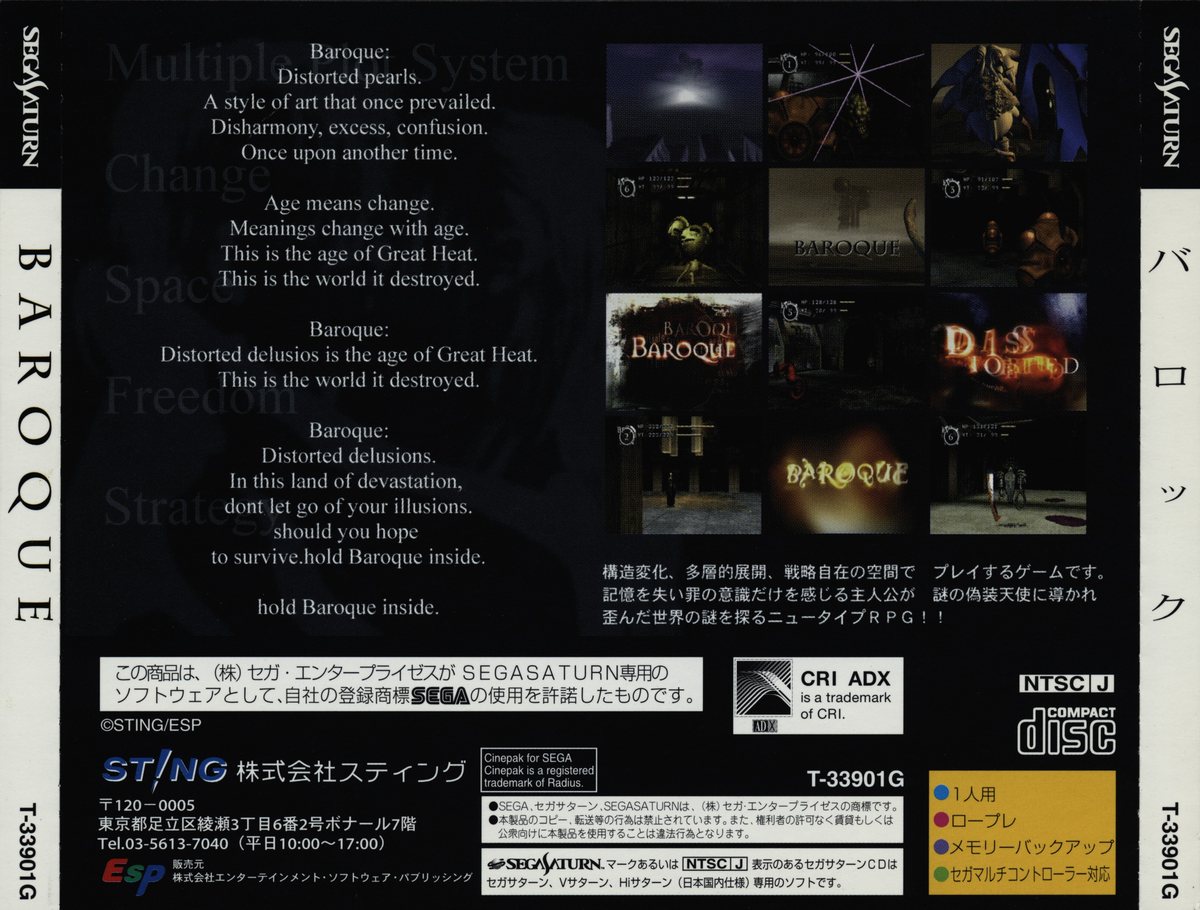
Back of the Baroque Sega Saturn box
THE BACK COVERThe back of the 1998 Saturn box, from the game's first life as a Japan-only release.

THE TIMELINE

From prototype to shelf
1996
Production begins at Sting. The game is announced the same year, two years before release, an unusually long public gestation for a Saturn title.
1997
Sting previews the game with the Baroque Report CD Data File, a promotional disc of art and music samples later given to pre-orders.
21 May 1998
Baroque ships for Sega Saturn in Japan, published by Entertainment Software Publishing at ¥6,800. DigiCube releases Masaharu Iwata's soundtrack the same day.
1998 to 2000
Sting keeps the world alive in print and spin-offs: the World Guidance sourcebook, the Baroque Report series, a prequel novella, a visual novel, a shooter, and a typing game.

THE LONG TAIL

A game that refused to stay finished
1999
The PlayStation port, Distorted Delusions, reaches the bigger audience the Saturn never had.
2007 to 2008
The remake: PS2 in Japan, then Wii, then North America and Europe in English. The original's first official life outside Japan, wearing new art.
2020
The Switch port restores the 1998 original itself, enhanced, a quiet admission of which version history kept.
Who Made Baroque?Why Baroque failed, and endured
MORE FROM THE BAROQUE ARCHIVE →
One shelf of the Library. Browse them all →

THE FIRST WORD

New pages and new pieces, first.