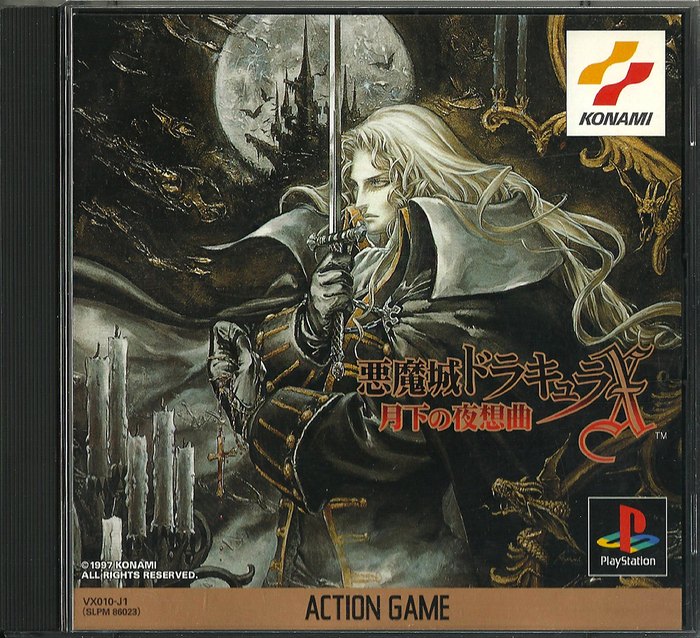
How is the Japanese Symphony of the Night different from the American one?
The original American PlayStation release removed exactly two familiars, added a sound test in compensation, and rewrote the dialogue, including its most famous line. Playable Maria and the Godspeed Boots are not Japanese PlayStation features at all: they belong to the Japan-only Sega Saturn version.
The familiars
Two cut, one song lostThe Japanese PlayStation version has seven familiars; the American has five. The two removed are variants: the Nose Demon, a Demon wearing a long-nosed tengu mask, and the Sprite, a Faerie variant who, if Alucard sits and waits, lands on his shoulder and sings a song called Nocturne. Konami even re-recorded the song in English, then removed the familiar who triggers it. The on-record explanation came from the American producer, Mike Gallo, in 1997: the two were cut because they worked exactly like the first versions of those familiars. In compensation the American version added a sound test, purchasable from the Master Librarian.
Maria
The correction that mattersMaria is not playable in the Japanese PlayStation version, and there is no unlock method, whatever the forums say. Playable Maria, selectable from the start alongside Richter, belongs to the Sega Saturn version, released only in Japan in 1998, which also adds two new areas, the Underground Garden and the Cursed Prison, a third hand slot for consumables, and the Godspeed Boots, a relic that lets Alucard run. Producer Koji Igarashi later disowned the Saturn additions in unusually blunt terms. The Maria most players know today comes from the PSP's Dracula X Chronicles port in 2007, where she unlocks after beating the game with a new, weaker moveset modelled on Rondo of Blood, and where the two cut familiars were also restored.
The dialogue
The famous line is AmericanThe prologue exchange everyone quotes, 'What is a man? A miserable little pile of secrets,' was written for the English version by localizer Jeremy Blaustein, borrowing from French novelist Andre Malraux. The Japanese line at that moment is comparatively plain. The PSP re-localization replaced the exchange entirely, which is why the line's survival is tied to the original American release. The Japanese release also came first, March 1997 against October in America, with Kojima's Alucard on the cover and an art book and soundtrack CD America never got.
THE GAME ON THE SHELF
Symphony of the Night · Japan