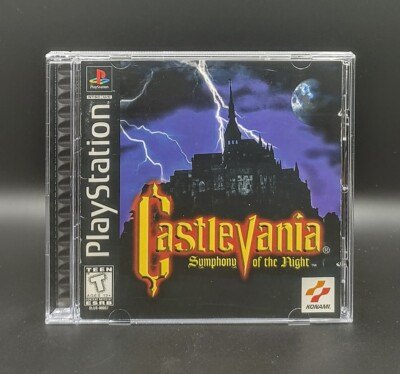
The History of Castlevania: Symphony of the Night
Five years after Richter Belmont destroyed Dracula in Rondo of Blood, the castle returns with Richter enthroned as its lord, and Dracula's son Alucard wakes from a three-century sleep to take it apart room by room. Castlevania: Symphony of the Night (PlayStation, March 20, 1997 in Japan; October 3, 1997 in North America) sold slowly, then would not stop selling: over 700,000 copies in the United States and Japan, on word of mouth alone.
THE MAKING
From a cancelled 32X game to a new directionThe game began in 1994 as a Castlevania for Sega's 32X, remembered under the title The Bloodletting. A playable prototype existed before Konami refocused on the PlayStation and cancelled it; the ideas were reworked into this game. Toru Hagihara, who had directed Rondo of Blood, directed and produced, with Koji Igarashi as assistant director, story writer, and programmer. Partway through, Hagihara was promoted to head the division and Igarashi finished the game.
Igarashi's own account of the design break is Tier 1 and unusually candid. The game began, he said, as "something of a side story for the series," which let the team break conventions. The motivation he names is retail: the sight of dozens of Castlevania games in the bargain bins of Japanese stores, because linear games offered little replay value once finished. He wanted a game that "could be enjoyed for a long time," looked to the exploration and backtracking of Nintendo's Zelda series, and acknowledged the direct influence of Super Metroid. The critical reception of Simon's Quest, the series' earlier exploration experiment, is what let him pitch it.
Two more decisions shaped the whole. The leveling system exists because Igarashi felt the earlier games were too challenging for average players; experience points let persistence substitute for mastery. And Alucard leads instead of a Belmont partly because the whip took up too much of the screen and the team wanted transformation abilities, bat, wolf, and mist, that a whip could not give. The game was also the video game debut of artist Ayami Kojima, whose character designs reset the series' face, while Michiru Yamane composed a score that moves from classical to thrash metal. The localization added its most quoted line: Jeremy Blaustein's "What is a man? A miserable little pile of secrets," borrowed from the French novelist Andre Malraux.
THE EDITIONS
One game, a shelf of versionsTHE RECEPTION
Acclaim, with the dissent keptThe dissent of 1997 was about the calendar. Entertainment Weekly called the visuals dated and flat next to 3D contemporaries such as Nightmare Creatures, and IGN's first review found the graphics close to the 16-bit games with animation that was not particularly smooth. The voice acting split the room: criticized widely, praised by GameSpot. Sales told the slower story: a mediocre commercial start, especially in America where it was meagerly publicized, then a word-of-mouth build to 703,166 units across the United States and Japan, 477,304 of them the American PlayStation version.
THE LEGACY
Metroidvania, and the disowned portThe genre word is this game's monument: the press fused Metroid and Castlevania into "Metroidvania" around Symphony and Super Metroid, and the model, an ability-gated castle opened by exploration, became the template for the series' next decade and for hundreds of games after it. The rankings accumulated: 16th on IGN's Top 100 Games of All Time, fourth on EGM's 100 greatest, with the inverted castle reveal listed among gaming's greatest moments. Original PlayStation copies are treated as collector's items.
The Saturn port stands as the documented counterweight. Igarashi said of its extra features, in 2007: "I understand why fans who've never played the Saturn version would be interested in those features, but I really, really don't feel good about them. I couldn't put my name on that stuff and present it to Castlevania fans." The port was never released in the United States, which makes the Japanese Saturn edition the only official way to play its two extra areas, and this Library's Japanese version page documents what else separates the regional releases.
THE GAME ON THE SHELF
Symphony of the Night · PlayStation