
From the Library: covers, censuses, and editions, documented. Browse the Library →
SOJ Bloodborne · The Making
← Back to the Library

How was Bloodborne made?

Made in parallel with Dark Souls II, in a smaller engine room, at a deliberate 30 frames per second.

Bloodborne and Dark Souls II were made at the same time, by different teams, which is why Miyazaki directed one and only supervised the other. Sony’s Shuhei Yoshida has said the partnership began when Japan Studio approached FromSoftware in 2012; the exclusivity, Miyazaki has explained, was partly practical: Sony simply presented its hardware developments first. Development proceeded under the codename Project Beast, and the game that emerged is a deliberate hybrid: Demon’s Souls’ hub structure rebuilt with Dark Souls’ interconnected world around it.

Some choices were aesthetic stands. The frame rate was targeted at 30 per second by design, for the atmosphere the team wanted, a decision players still debate a decade on. Others were budget physics: the chalice dungeons, procedurally generated, exist because hand-building that much game was impossible. The soundtrack alone took about two and a half years: over 80 minutes from six composers, a 65-piece orchestra and a 32-voice choir.
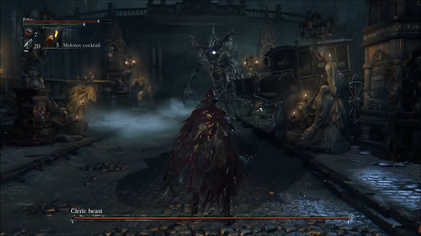
Bloodborne alpha build gameplay in Central Yharnam
THE ALPHA Bloodborne in its 2014 alpha build: Central Yharnam before release, from the network test that let players walk the city early.

THE PRODUCTION, IN PARTS

2012 to 2015
Two games at once
Releasing a Miyazaki-directed Bloodborne beside a supervised Dark Souls II in consecutive years split the studio, and produced two very different games from one design culture in the same twenty-four months.
The Dream as Nexus
The Hunter’s Dream is the Nexus rebuilt: a quiet workshop outside the world, a doll to level with, a house that slowly fills with implications. The hub was kept because it works; the atmosphere was deepened because it could be.
A Sony game to the end
Japan Studio co-developed and Sony published; when the remake studio Bluepoint later pitched updating Bloodborne, they were told FromSoftware was not interested. The chain of ownership around this game is unusually personal.
More from the Library
MORE FROM THE FROMSOFTWARE ARCHIVE →
One shelf of the Library. Browse them all →

THE FIRST WORD

New pages and new pieces, first.