
From the Library: covers, censuses, and editions, documented. Browse the Library →
SOJ Dark Souls · The Design
← Back to the Library

How was Dark Souls designed?

One kingdom, folded over itself: you can see the end of the game from the beginning, and walk there.

Lordran is the design. Dark Souls’ first half is a single interconnected structure, shrine, parish, depths, garden, fortress, and the shining city above all of it, in which shortcuts keep returning the player to the one safe fire. The geography is the difficulty curve, the tutorial, and the story’s evidence locker at once. Miyazaki, who has final say on level design across his games, builds from architecture: Anor Londo, the city of the gods, takes its forms in part from Milan Cathedral and the Château de Chambord.

The bonfire is the other half of the design. Resting restores everything, health, spells, the world’s enemies. Safety and reset are the same button, so every rest is a decision: the design makes comfort cost exactly the progress it protects.
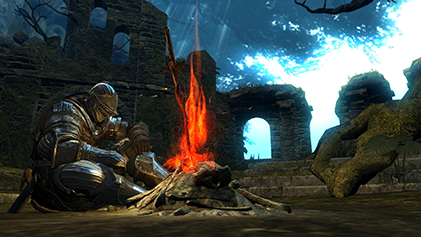
A knight resting at a bonfire in Dark Souls
THE BONFIRE The bonfire: checkpoint, heal and respawn point in a single lit sword. Resting refills the Estus Flask and resurrects nearly every enemy in the world — the reset at the heart of Lordran’s design.

THE PRINCIPLES

As documented in the game’s own structure
Sightlines as promises
From Firelink Shrine the player can see the parish walls and the fortress; the game teaches its map by showing destinations hours before they are reachable. Exploration is paying off views.
Death, itemised
Die, and your souls wait where you fell; die again on the way back and they are gone. The system turns the walk back into the real level, a route you now know, at stakes you now feel.
Strangers, silently
Ghosts of other players flicker through your world; their bloodstains replay their deaths; their messages warn or lie. Miyazaki’s stated model was drivers helping each other up a snowy hill, unknown and unthanked.
No canonical hero
The protagonist’s gender, face and class are the player’s; the design treats the chosen undead as a vessel, and puts the identity in the build, stats, weapons, covenants, instead.
More from the Library
MORE FROM THE FROMSOFTWARE ARCHIVE →
One shelf of the Library. Browse them all →

THE FIRST WORD

New pages and new pieces, first.