From the Library: covers, censuses, and editions, documented. Browse the Library →
SOJMonster Hunter · The One That Stayed Home
← Back to the Library

What was Monster Hunter Portable 3rd?

The fastest-selling PSP game in Japanese history, and the biggest Monster Hunter the West never officially got.

Monster Hunter Portable 3rd launched in Japan on December 1, 2010, and detonated: 2.58 million copies in two weeks, three million shipped in seventeen days, the fastest-selling PSP title Japan had ever seen and, at that moment, the fastest-selling game in Capcom’s history. PSP hardware sales spiked past 326,000 units in its launch week as Japan bought the machine to play it. Lifetime sales reached 4.9 million, almost entirely inside one country.

The game itself was a celebration: a new, Japanese-style hot-spring village, Yukumo; every weapon type restored after Tri’s cuts; and a new flagship, the thunder wolf Zinogre, one of the most beloved designs in the series. An HD remaster followed on PlayStation 3 in August 2011 as the first of Sony’s PSP Remasters. The West received neither version. Portable 3rd remains the great absence in the series’ Western library.

THE RECORDS

December 2010
Famitsu 39/40
Critics matched the public: Portable 3rd scored 39 of 40 in Famitsu, near the magazine’s ceiling, and topped the Japanese chart by unseating Gran Turismo 5.
The hardware effect
A single game moved a mature handheld’s weekly sales roughly tenfold, the clearest measure of what Monster Hunter meant in Japan at its peak.
Why it stayed home
Capcom never announced a Western version. By the time a localisation could have shipped, the PSP market in the West was collapsing, and the series’ future had already moved to Nintendo hardware.

THE COVER

Japanese edition
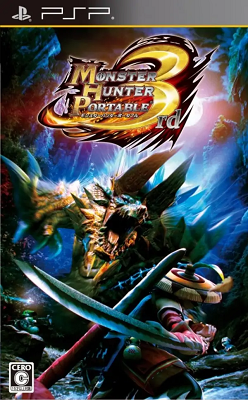
Monster Hunter Portable 3rd, Japanese PSP cover, 2010
Portable 3rd · PSP · 2010
Zinogre, wreathed in thunder, over a Yukumo hunter: the Japanese cover of the fastest-selling PSP game in the country’s history.
The hunter’s place
Note the composition: the hunter is small, low in the frame, and looking up. Japanese Monster Hunter covers are portraits of the monster; the human is there for scale.
CERO C
The Japanese box carries a CERO C rating, for ages fifteen and up: a small reminder that this phenomenon was never aimed at children.

More from the Library

MORE FROM THE MONSTER HUNTER ARCHIVE →
One shelf of the Library. Browse them all →

The First Word

New pieces reach subscribers first, before they are listed anywhere. One short letter, only when there is something worth your time.