
What does the Ancient Mew card actually say?
Ancient Mew looks like a prop because it was one. In Pokémon: The Movie 2000 (in Japan, Revelation Lugia), the collector Lawrence III treasures an ancient Mew card, the piece that started his collection; in the English dub he says so outright. The real card was made to match: a Mew in a stone frame, its text carved in a mixture of Germanic runes, drawn from Futhark and related alphabets, with Mayan-style glyphs in the art. The runes are not used for their sound values. They are a cipher: each rune stands for a letter of the Latin alphabet, so the card can be read, letter by letter, by anyone with the key.
With the key, it is an ordinary card wearing a costume. Ancient Mew, 30 HP, Psychic type. Its single attack is Psyche, for two Psychic Energy, doing 40 damage, the Pokémon move Psychic under an older name. Its Pokédex line reads "New Species," and its flavor text asks the question the whole film asks about Mew: "Little God... or Evil?" Even its weakness and resistance are printed only as symbols tucked into the stonework, findable, as collectors later noticed, on the Xatu totem pole on the cover of the Neo Premium File 2.
The key was never secret for long. Japan's CoroCoro magazine published the complete lexicon in its September 1999 issue, runes, translation and the meanings of the four Mayan glyphs, and Wizards of the Coast handed out rune cheat sheets at its events in the West. None of which saved the card in organized play: a card your opponent cannot read is a card that cannot be argued with fairly, and Ancient Mew was banned, one of only two cards ever banned even from the anything-goes Unlimited format. It shares that distinction with Birthday Pikachu, the other page in this shelf where the joke was the rules. Who designed it, fittingly, is unknown: the card carries no illustrator credit.
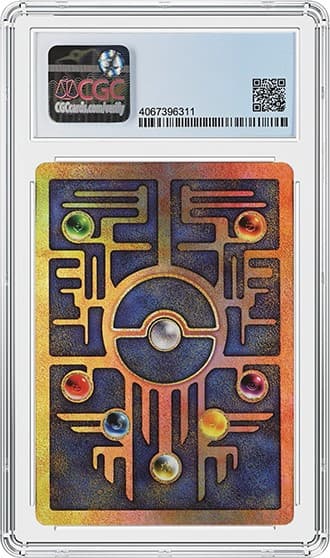
Ancient Mew, front and back
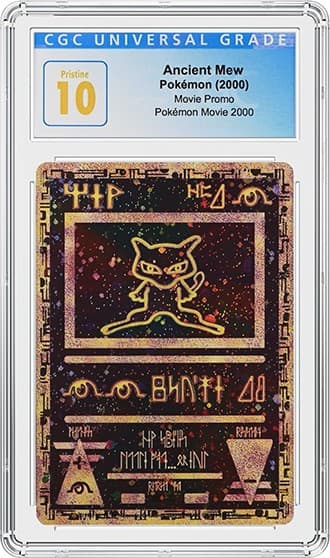
The four glyphs worked into the artwork are Mayan in style, and the official reading gives them as Birth (upper left), Enthronement (upper right), Right of Succession (lower right) and Death (lower left): a whole royal biography in four marks.