
From the Library: covers, censuses, and editions, documented. Browse the Library →
SOJ Serial Experiments Lain · The Game
← Back to the Library

What is the Serial Experiments Lain PlayStation game?

A PlayStation disc that refuses to be a game: a psychiatrist’s filing cabinet, a girl’s diary, and two CDs of other people’s notes about Lain.

On November 26, 1998, two months after the anime ended, Pioneer LDC released Serial Experiments Lain for the PlayStation, in Japan only. It was designed by the anime’s own makers, Chiaki J. Konaka and Yasuyuki Ueda, and its scenario had been written before the anime’s. The creators declined to call it a game at all: their word for it was “Psycho-Stretch-Ware.” It was sold as a network simulator, under the slogan “Close the world, Open the nExt.”

You do not play Lain. You are let into a database, therapy session recordings, Lain’s diary, her psychiatrist’s case notes, short videos, and you unlock files in an order closer to accident than plot. The design aim, in the team’s own phrasing, was for the player to “feel” Lain, “to understand her problems, and to love her.”
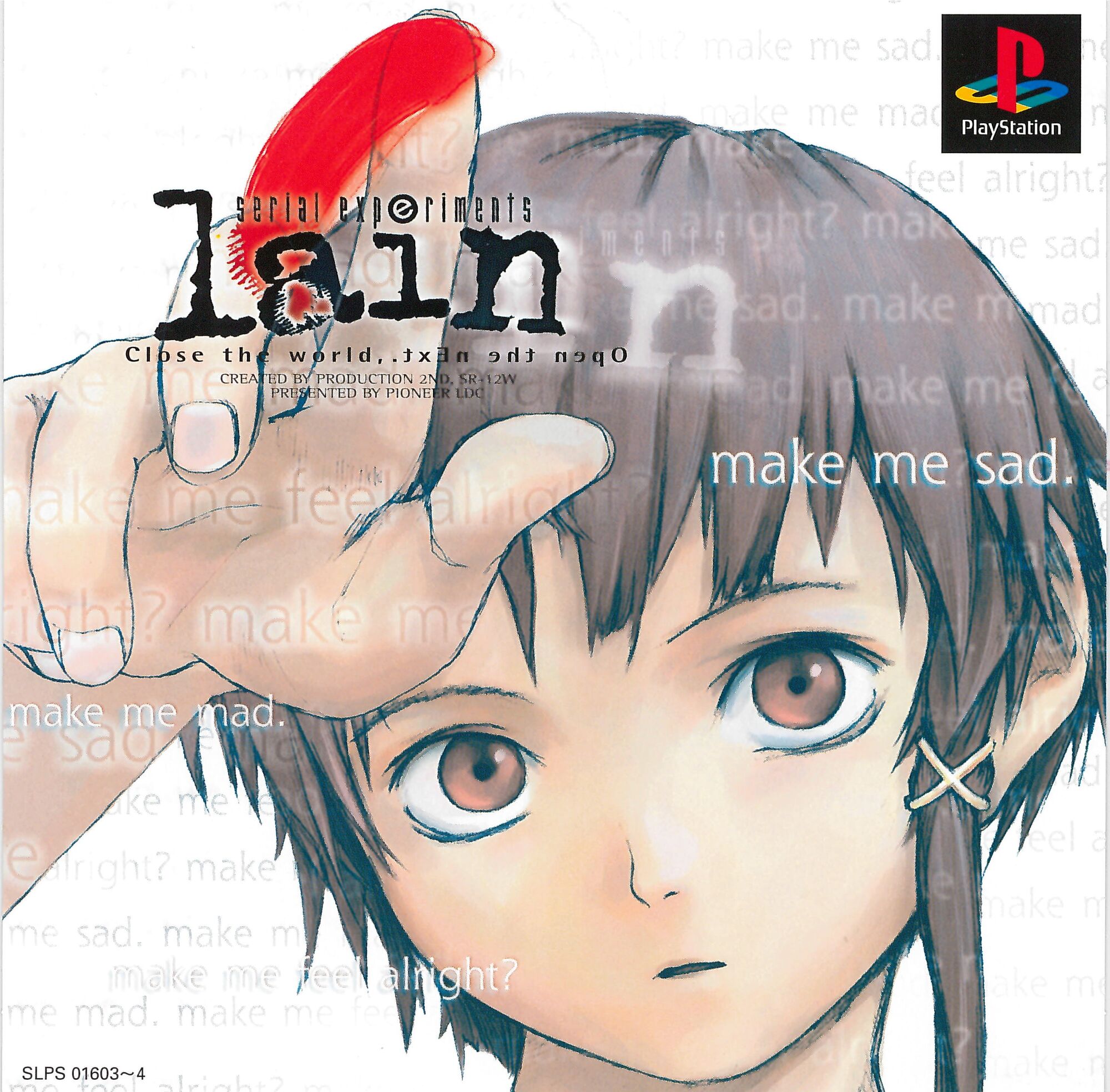
Serial Experiments Lain PlayStation game cover, 1998
CLOSE THE WORLDThe 1998 PlayStation game's cover: ABe's Lain reaching toward the player.

THE FILING SYSTEM

How it actually works
Files, not levels
Progress is measured in documents: audio of Lain’s sessions with her psychiatrist Touko Yonera, Touko’s private notes, Lain’s own diary entries, and video fragments. There is almost nothing to solve; there is only more to read, hear, and watch, deliberately more than anyone can sort.
Random order, on purpose
Information surfaces partly at random, so no two players assemble the same Lain. The authors wanted the feeling of a network’s overload: myriads of information, and always less of it than exists.
Two discs, one guidebook
The game shipped on two CD-ROMs, and MediaWorks published the Serial Experiments Lain Official Guide alongside it in late 1998, the paper companion the database withholds.

THE RECEPTION

Ignored, then excavated
1998: a shrug
Unlike the anime, the game drew little attention on release. Reviewers praised its visuals and criticized nearly everything else: the lack of gameplay, the interface, the interminable dialogues, the absence of music, the long loading times. Dengeki PlayStation’s two reviewers scored it 70 and 55.
The long verdict
Later critics have been kinder about what the shrug missed: the game is now cited as a precursor to works like Her Story and What Remains of Edith Finch, narrative assembled from searched fragments, decades early.
The collectors’ verdict
By 2024 the market had spoken in its own language: an unused, sealed copy of the game was valued at around US$3,400 in Japan. A filing cabinet, it turns out, can be a treasure chest.

KEEP GOING

Inside the database
The Lain GalleryMore from the Library
MORE FROM THE SERIAL EXPERIMENTS LAIN ARCHIVE →
One shelf of the Library. Browse them all →

THE FIRST WORD

New pages and new pieces, first.